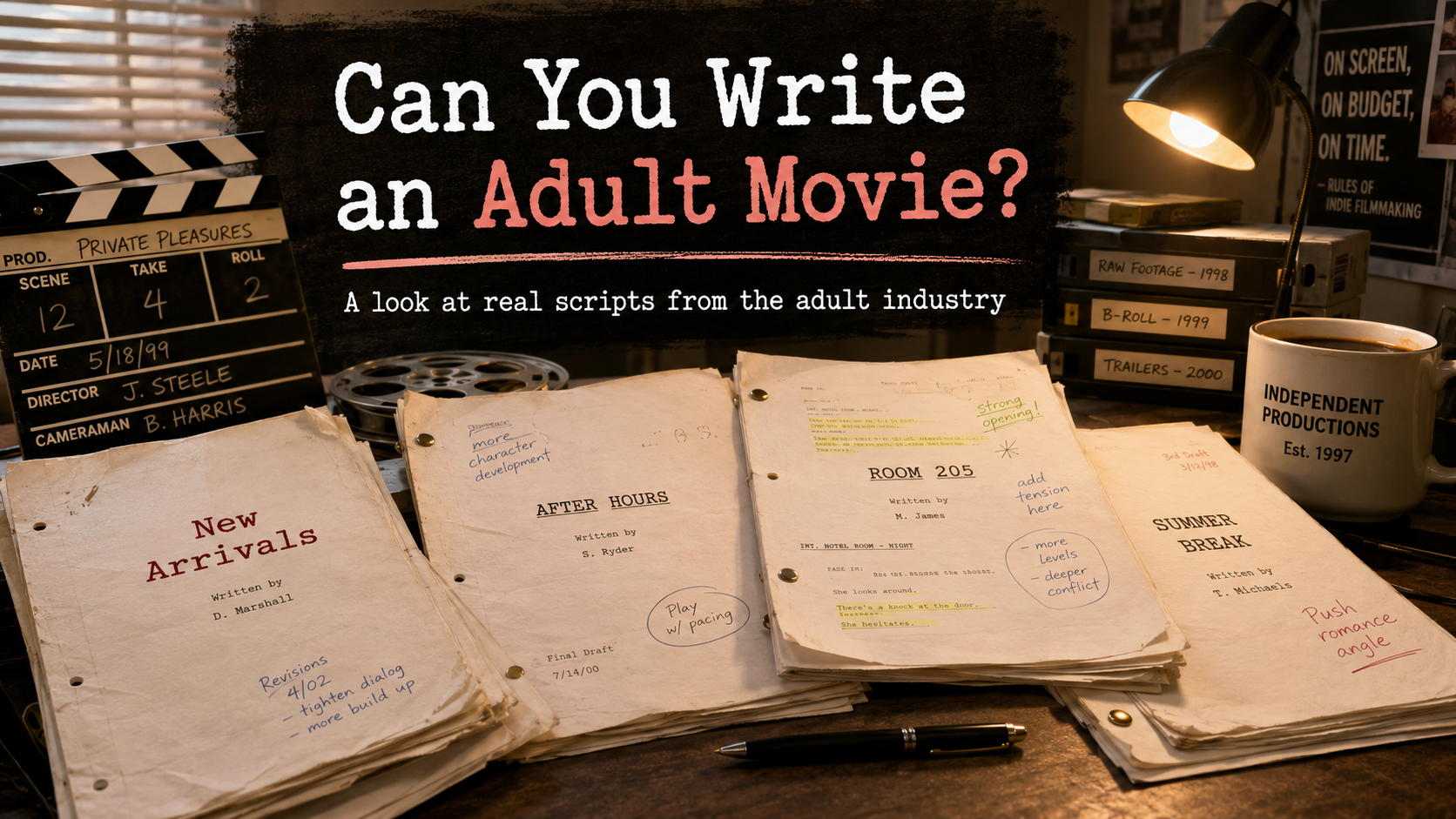
As of August 26, 2026, I’ve officially been working in the adult industry in one capacity or another for 30 years and I’ve worked for many amazing companies during that time including several studios. During those three decades, I’ve been asked just about every question you can imagine, but two questions come up more often than almost anything else.
The first is, “How do I get into the adult industry?” I get that one so often that I eventually created an entire free class about it at Performer.Training. I seriously get that question so often that it just became easier to write it all down. The second question is a little different:
“Can I write an adult movie?”
For years, I haven’t really bothered giving people much of an answer to that one.
It isn’t because adult movies don’t have scripts. Plenty of them do. It’s because writing adult movies generally isn’t a career path in the way people imagine screenwriting for Hollywood.
Adult production companies typically don’t have the budgets to employ professional screenwriters, maintain writers’ rooms, or pay someone thousands of dollars for a screenplay.
We aren’t Hollywood. 😁
That doesn’t mean nobody writes these movies, of course. Someone has to come up with the story, characters, dialogue, locations, transitions, and everything else necessary to get the production from an idea to something that can actually be shot.
And some people are genuinely fascinated by how that works.
So rather than trying to explain it entirely in the abstract, I thought it would be much more interesting to show you.
These Are Real Adult Movie Scripts
I dug through my files and pulled out several actual scripts from companies I’ve worked with over the years.
Some have survived the years better than others. A few are nice, clean copies. Others have been photocopied, faxed, written on, highlighted, revised, punched for binders, and generally look exactly like documents that spent time being passed around during an actual production.
Personally, I think that makes them more interesting.
These aren’t screenplay templates I downloaded from the internet, and they aren’t examples I created specifically for this article. They’re scripts that were actually produced within the adult industry.
And right away, they demonstrate something important: there is no single universal format for an adult movie script.
I imagine super directors like Mike Quasar and Jim Powers who do what they do so many times a day probably don’t even need scripts. They bang out so many scenes in a week they have what they do down to an artform.
The First Thing You’ll Notice Is How Short They Are
If your idea of a screenplay comes from mainstream filmmaking, one of the biggest surprises is probably going to be the page count.
- Portrait of Passion [script] is 13 pages.
- All the Rave [script] is 14 pages.
- Petals [script] is 16 pages.
- The Sixth Reflection [script] is 18 pages.
- Hocus Pocus XXX [script] is 18 pages.
- Ladies of Light [script] is 19 pages.
- The Garden Party [script] is 20 pages.
- Tycoon [script] is 20 pages.
- Scandalous [script] is 22 pages.
- The Reunion [script] is 26 pages.
- Tales of Lace [script] is 26 pages.
That alone should tell you quite a bit about how differently these productions were approached.
A traditional Hollywood screenplay often follows the rough assumption that one screenplay page equals about one minute of finished screen time. That isn’t especially useful when looking at an adult script because substantial portions of the finished movie may not require pages and pages of scripted action or dialogue.
Instead, the screenplay primarily has to get the production from one narrative point to another and establish the circumstances surrounding the individual scenes.
You can see that very clearly in Scandalous. The script contains ordinary numbered dramatic scenes with headings such as INT. JANE AND CHRIS'S BEDROOM -- DAY, dialogue, character directions and transitions. When it reaches one of the movie’s sex scenes, however, it can simply identify it as something like SS #1 along with the performers or characters involved and the type of scene.
Later in the same script, another scene is essentially reduced to a setup followed by SS #2 JIMMY and GINGER B/G.
That is one of the reasons a feature-length adult movie does not necessarily require a feature-length screenplay.
Some Look Surprisingly Much Like Regular Screenplays
If you look at Scandalous, it may be considerably more conventional than you were expecting.
It opens with the production information and writing credits, then immediately goes into a numbered interior scene, gives us the location and time of day, describes the action, and places character names and dialogue underneath.
It also uses standard filmmaking language throughout the script: DISSOLVE TO, CONTINUOUS, FLASHBACK, INTERCUT, close-ups, music montages and other shooting instructions.
There is an actual plot, too. The script begins with Jane believing Chris has been unfaithful, then jumps backward two days to show the series of events that created that misunderstanding. By the end of the story, Michael confesses that he planted evidence against Chris, Jane realizes what happened, and the plot is resolved.
In other words, it isn’t simply a list of sexual scenarios. It is attempting to tell a story in which those scenes occur.
But Compare That With All the Rave
This is where the examples become particularly useful.
All the Rave [script] looks much less like a pristine screenplay sitting on an aspiring Hollywood writer’s desk and much more like a working production document.
The surviving copy is a 14-page second draft dated May 15, 2001, credited to Philip O’Toole. Right on the first page you can see handwritten production notes in the margins.
Its formatting is much looser as well.
Instead of long stretches of fully developed screenplay dialogue, there are short scene identifiers, camera directions, narration, character descriptions, interview segments, flashbacks and extremely concise instructions about what the production needs to capture.
That difference matters because it gets us away from the idea that there was some secret Adult Film Screenwriting Bible everyone had sitting beside their computer.
There wasn’t.
The Garden Party Takes Yet Another Approach
The Garden Party [script] written by Nick Orleans and dated September 24, 1997, is 20 pages long. Its opening page uses numbered scenes, traditional INT. and EXT. location headings, descriptions, dialogue and explicit camera instructions such as establishing shots and closer shots of characters.
The script also uses a framing device involving a garden diary. Rebecca reads from it, and those entries lead the audience into different vignettes.
That gives the writer a practical structure for the entire movie. Instead of needing one elaborate continuous narrative that somehow connects every sequence, the diary provides a believable mechanism for moving from one story to another.
That is worth paying attention to if you’re interested in writing something like this. The storyline isn’t only there for artistic reasons. The structure has to serve the realities of the production.
Some Scripts Were Much More Detailed Than Others
Another excellent comparison is Portrait of Passion [script].
The surviving script is only 13 pages, but the opening is remarkably specific. It begins with a title montage, describes the artist’s hand and brush, specifies watercolor being applied to a canvas and tells us when the camera pans out to reveal the subject of the portrait. It then fades into the next scene and introduces Lila at Branford College.
A few pages later, you even see an *EDITORS NOTE before dialogue from the dean begins.
So despite being short, this wasn’t necessarily just a rough outline saying, “Character A meets Character B, something happens, move to the next scene.”
Someone was thinking visually.
You Can Also See the Production Process in the Pages
This may be my favorite part of looking through old scripts.
The Reunion [script] is a 26-page Nicholas Steele Productions script written by Peter Wood. My copy doesn’t just contain the story. The pages are marked with different script revisions, including White Revision, Blue Revision and Pink Revision, along with revision dates.
That might seem like an insignificant detail, but it tells you something about these productions that gets lost when people talk about adult movies from the outside.
They were still productions. Scripts changed. Pages changed. Scenes changed. Someone had to keep track of which version people were working from.
Likewise, my copy of All the Rave [script] contains handwritten notes and highlighted passages. These weren’t sacred literary documents. They were tools being used to make a movie.
Sometimes What You Have Isn’t Even Really a Traditional Script
In Hollywood terms “a movie treatment is a short summary of a story written like a prose story, while a script is the full blueprint of the movie with scene headings and dialogue”, but this is porn and we aren’t so fancy. When it comes to production, you get what you get no matter what anyone calls it.
In Hollywood, treatments are usually 5 to 25 pages long. Feature film scripts are typically 90 to 120 pages long (where one page equals about one minute of screen time). That is not the case in porn. But I still wanted you to have a basic idea of what these words mean in the mainstream Hollywood.
Take a look at The Sixth Reflection [Script]. This was a movie that was made in December of 2001 for Adam & Eve.
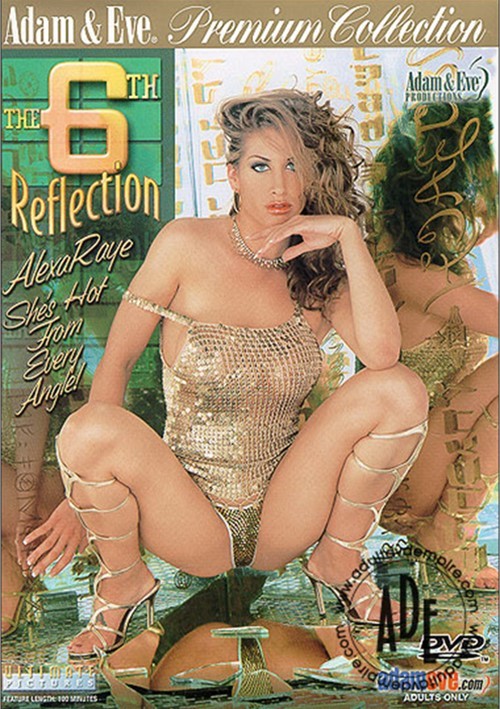
The first surviving page calls itself a treatment, and it begins by describing the basic premise and characters before moving into the screenplay material.
That distinction is useful because people sometimes become obsessed with getting screenplay formatting exactly right when the practical question should be: Can the people making the movie understand what they’re supposed to shoot?
Professional screenplay formatting exists for good reasons, and knowing it certainly doesn’t hurt. But these examples show that adult companies weren’t necessarily rejecting an idea because somebody’s margins were half an inch off.
The document had a job to do.
Story Still Matters
There is another misconception these scripts help dispel. Writing an adult feature didn’t necessarily mean inventing increasingly elaborate excuses for people to have sex.
Look at Scandalous [script]. This was a movie from 2005 (ish).
There is a domestic conflict, deception, a mysterious caller, gambling debts, planted evidence, jealousy and ultimately a reveal that explains what happened. The sexual scenes exist inside that storyline rather than replacing it.
The Reunion [script] builds its premise around former classmates reconnecting at a high school reunion. Early pages establish several characters separately before bringing them toward the reunion itself.
The Garden Party [script] uses the diary to connect its vignettes. All the Rave [script] revolves around the rise of Rebecca Rave and the rave-club world surrounding her. Portrait of Passion [script] builds its story around an art student and the people she encounters at college.
These aren’t necessarily enormously complicated plots, nor do they need to be. They give the movie a premise.
Hocus Pocus XXX
When I wrote my first movie Hocus Pocus XXX in 2010, I started out by writing out all the notes I had in my head, how I saw the movie playing out. Then I used that to turn it into a more traditionally formatted script.
Of course not everything works out how you imagine in. In my case, I had intially cast Brynn Tyler, Kiara Diane and Sunny Leone for the town girls in the movie opening. But as it turned out Brynn Tyler’s agent wouldn’t let her get cast with Kiara Diane who was with another agency at the time. So Brynn was out and I instead replaced her with the amazing Madelyn Marie.
But as you can see in the original script, it had called for Brynn Tyler in her place.
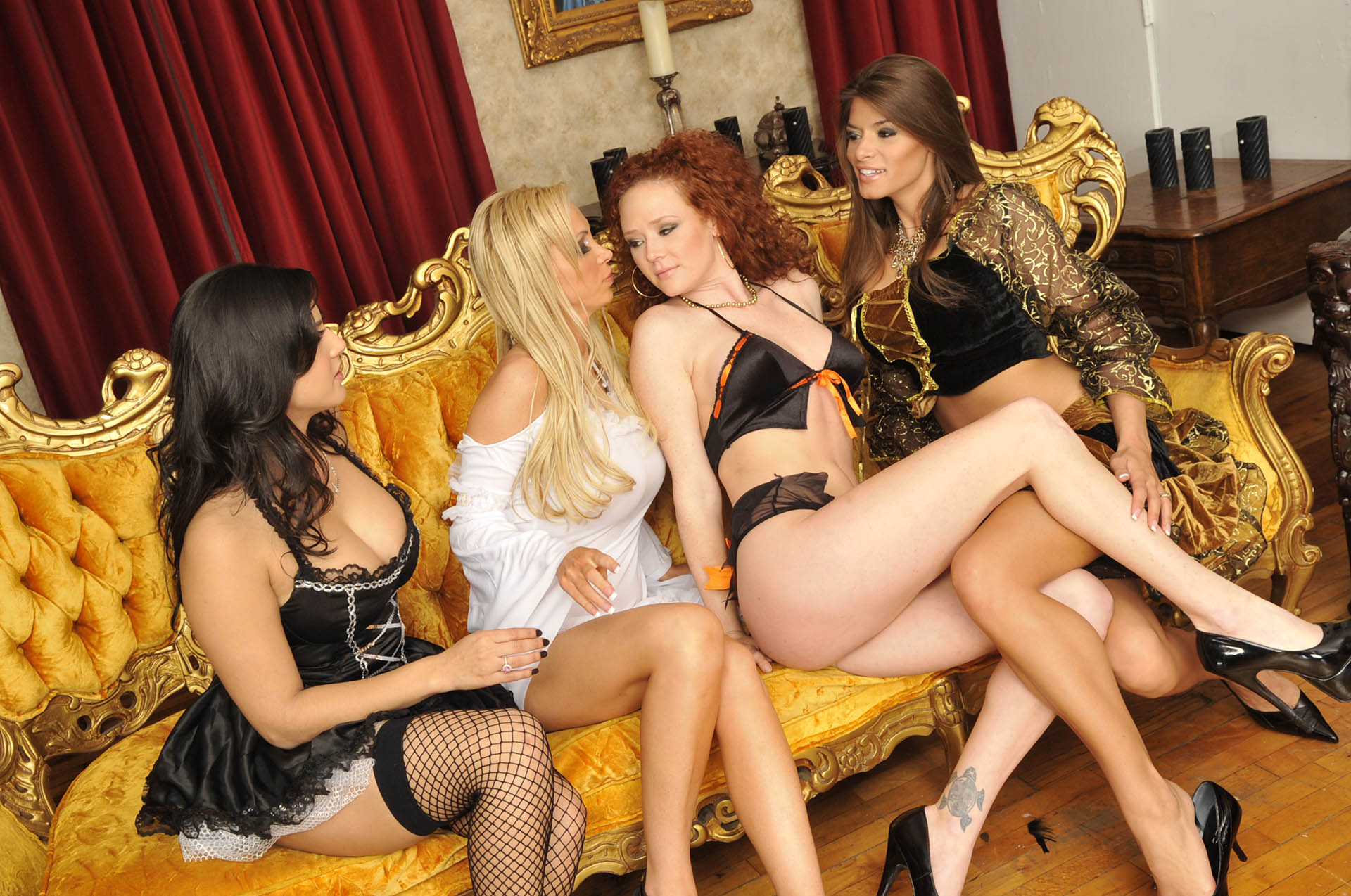
In the next scene in the movie (modern day museum) you can see in the script it originally called for 3 people, Mckenzee Miles and Amia Miley who were getting the museum ready for the Halloween party and Rocco Reed. But as it turned out Eva Angelina had really good chemistry with Rocco and wanted to make a last minute switch. So that scene became Amia Miley, Mckenzee Miles and Michael Pacino but then at the very very last minute, one of the agents I worked with offered me a really good deal to add Sea J Raw to the cast so we made her into a ghost in that scene for it became a boy/girl/girl scene with a solo/anal girl watching on. I mean because, why not?
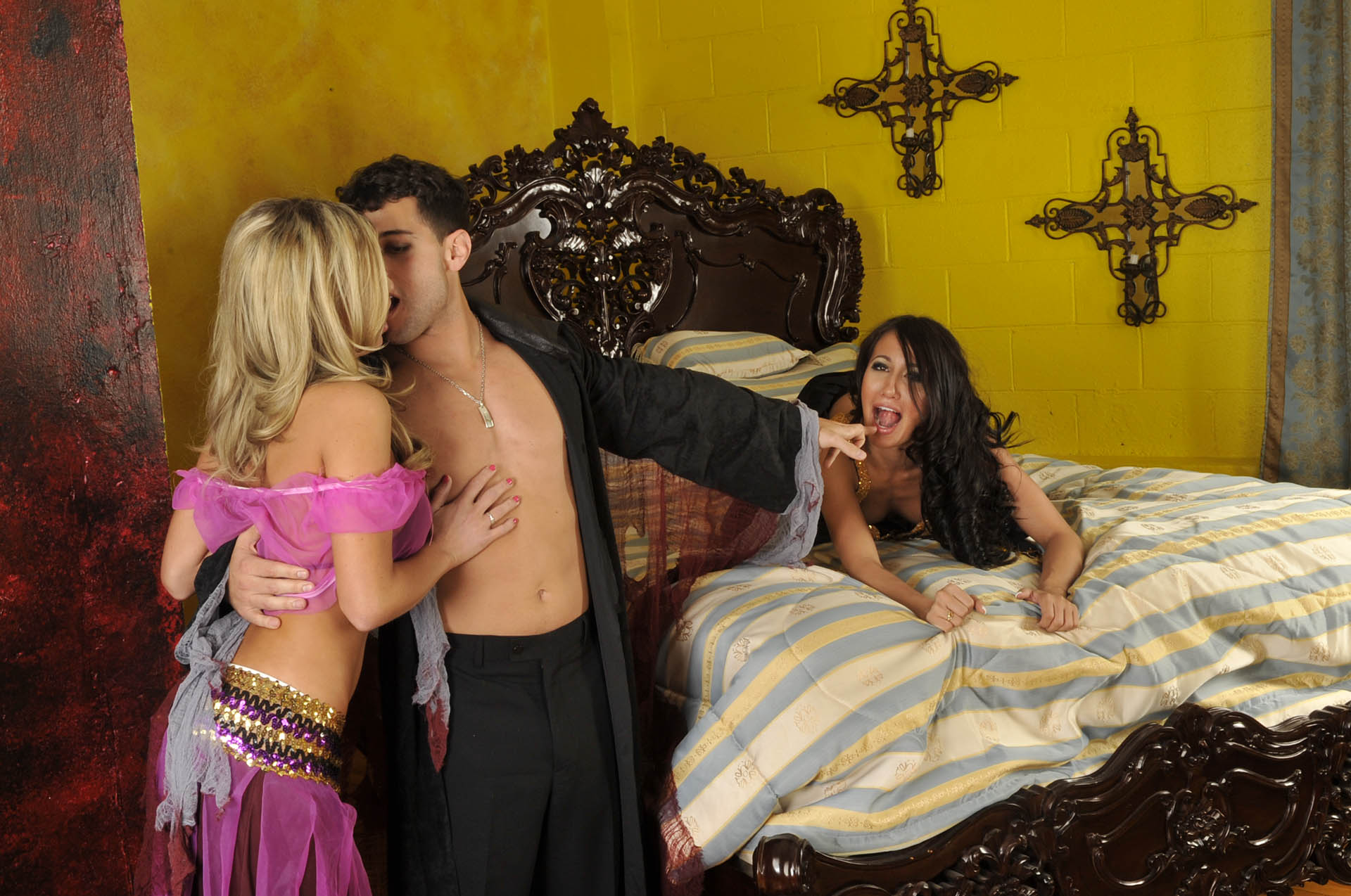
Anyway the point of all of this was to show you that sometimes even what you put down on paper doesn’t work out perfectly when it comes to actually making the movie itself. Consider them rough production notes.
So, Can You Write an Adult Movie?
Absolutely. The more complicated question is whether somebody is going to pay you to do it.
This is the part people usually don’t want to hear.
There has never been anything particularly strange about writing a script for an adult movie. You need characters, a premise, locations, dialogue, transitions and enough information for the director and production crew to understand what is supposed to happen.
But “adult screenwriter” has never been a particularly realistic standalone career path.
Adult production budgets are nothing like Hollywood budgets. In many cases, writing duties may be handled by a director, producer, owner, performer or someone else already involved with the production. Paying a professional writer simply adds another expense to a movie that is already being made under tight financial constraints.
That’s the real reason I usually don’t have a particularly satisfying answer when somebody tells me they want to write adult movies professionally.
It’s not that the scripts don’t exist. It’s that the economics generally don’t support the profession they’re imagining.
Bluebird Films “Treatments”
Every production company is different. While some use note sheets, other use full scripts and yet others like Bluebird Films used treatments more than scripts.
Paul Chaplin wrote the scripts for every movie. And keep in mind he’d in some cases spend millions to produce a movie. What he would do is start with a treatment and that was be used as the production bible.
Murder Mystery Weekend is a series that Bluebird Films made, which was a total of 27 scenes over 3 movies. [script]
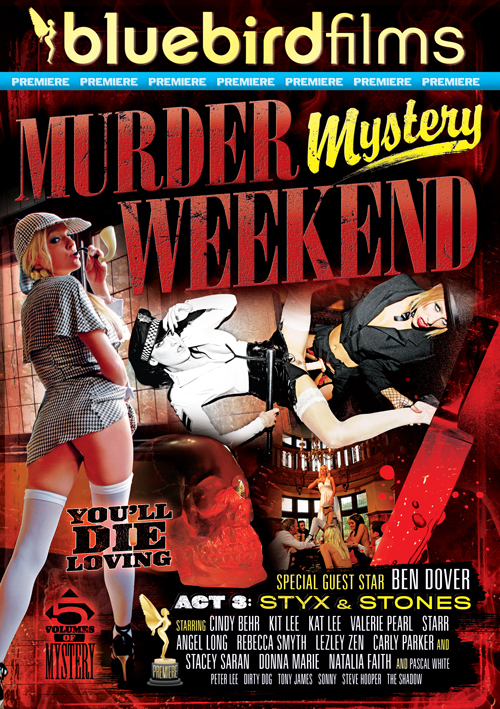
Remember the movie Clue (yes like the board game). Anywho this was a movie based on that. Anywho the point is, this was a big budget movie filmed in a real castle with a big cast, tons of costumes, etc. But the movie used a treatment for production or what he would call his production bible, as opposed to a traditional script.
If Paul had very specific lines he wanted the performes to say, he would feed them to them on the day of shooting.
But it wasn’t just his big budget movies he did the film treatments for either. Here’s one he did for the movie DP4 [script]. It’s just your run of the mill gonzo type movie. I should point out that “run of the mill” for Bluebird Films. Most studios don’t have a regular movie with a cast of 36 people.
So on the cast list, he would note the character’s name, who who going to be that character (Like Madelyn Marie was playing the character os Serena). then he would note any unique descriptio so you understand their role, what kind of costume they might need or what the person needs to look like (pre-casting).
Like for the character of Matthias, Paul Chaplin had in mind a long haired hunk, but someone who was ‘nastier than Evan Stone’. Evan Stone for those who don’t know was well known for his acting skills. He was actually quite talented.
The next line mentions the character Olin. Olin is described as a “Cigar smoking, chess playing assissin [think Tom Cruise in collateral]”.
This DP4 [script] document is how Paul Chaplin treated all of his movies. It wasn’t real written out production instructions, not just for how the scenes would play out but how he saw it all playing out in his mind.
What You Should Take From These Scripts
If you’re still fascinated by the idea, however, I think these old scripts are incredibly fun to study.
Don’t obsess over copying any one of them exactly. They span different companies, writers, productions and years, and even this small collection demonstrates how dramatically the format could change from one project to another.
Instead, pay attention to what they have in common.
They establish locations quickly. They tell the production who is in the scene. They provide the dialogue needed to move the story forward. They describe important visual action. They identify transitions. They make the sexual sequences obvious to the people planning the production. And perhaps most importantly, they don’t waste a lot of pages getting there.
That’s probably the biggest lesson in the entire collection.
An adult movie script isn’t necessarily trying to impress a literary agent or survive a studio development process involving fifteen executives. It’s a practical document written for people who need to turn those pages into a finished movie.
And sometimes seeing the real thing explains that better than I ever could.
The Real Scripts
Below are some real adult film scripts I’ve included with this article. They’re presented as historical examples of how different adult production companies and writers approached screenplay and treatment formatting, not as a universal template that every company followed.
If nothing else, I hope you have as much fun looking through these little pieces of adult-industry history as I did digging them out.
- All the Rave [script]
- DP 4 [script]
- Hocus Pocus XXX [script]
- Ladies of Light [script]
- Murder Mystery Weekend [script]
- Portrait of Passion [script]
- Petals [script]
- Scandalous [script]
- Tales of Lace [script]
- The Sixth Reflection [script]
- The Garden Party [script]
- The Reunion [script]
- Tycoon [script]
Times Have Changed
Something worth mentioning is that the industry has changed over the years. We don’t often make full movies anymore. More often than not we produce single one-off scenes and at times combine those of a similiar theme into a full connection and call it a full movie but for the most part the days of making full 5-6 scene “movies’ are really not a thing anymore. Well it does happen with a few studios like Digital Playground but it’s rare.
Digital Playground is trying to bring the concept back and I’m all for it. Here are two examples of full length movies Digital Playground is producing. These are movies where they follow traditional scripts.
If you enjoyed this story be sure and give me a follow on X at @misskellixxx.
About The Author