If you create a video, the content of that video is now your legal responsibility. Claiming ignorance of the law doesn’t protect you. It’s your responsibility to know the law. And just because someone else has posted something similar doesn’t matter. What matters is what you’ve done.
Most adult creators assume that if something is filmed and posted online, it must be protected by free speech. That assumption is wrong, and if you are a content creator, it’s important you understand what you can and can’t do and how those rules can vary by country.
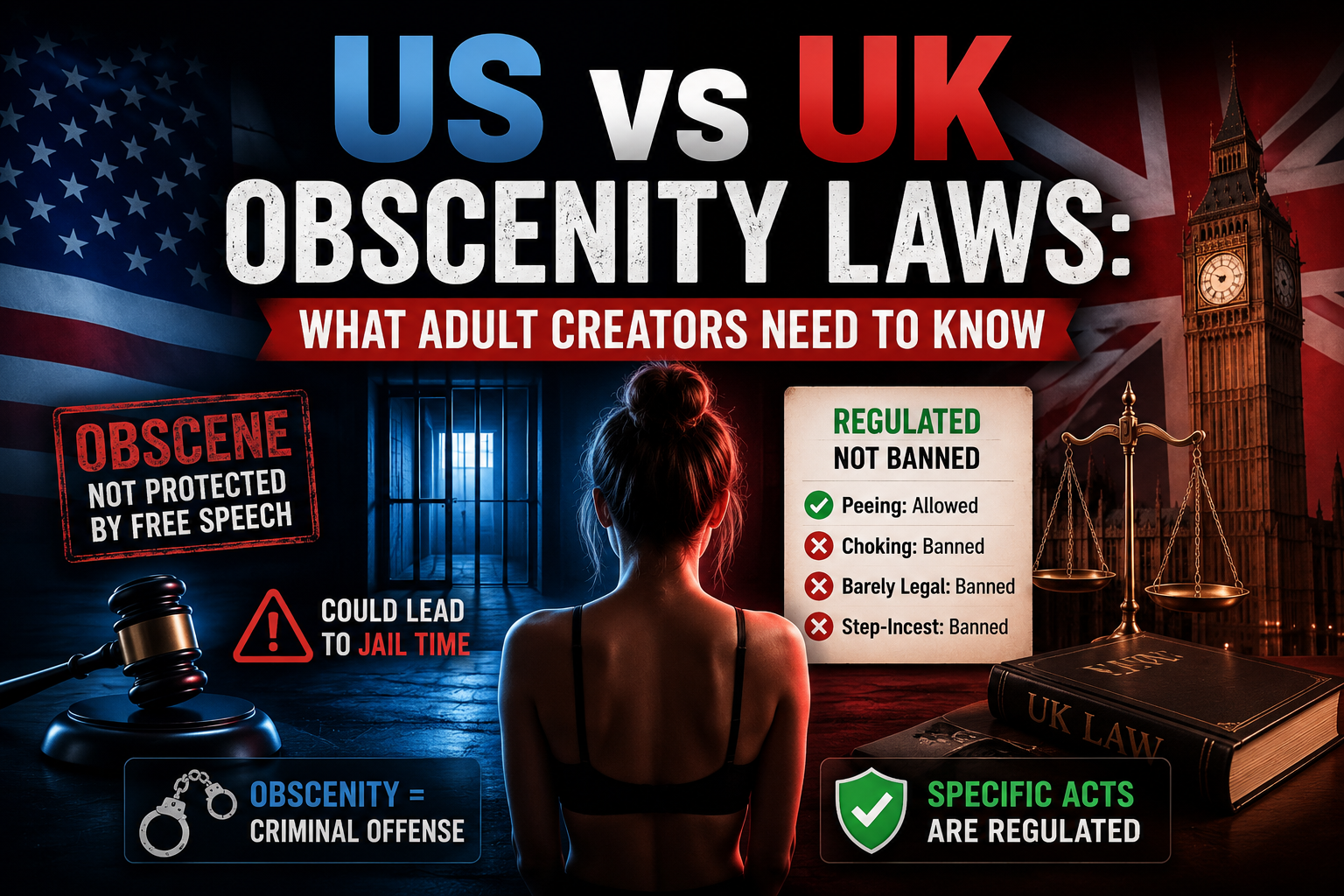
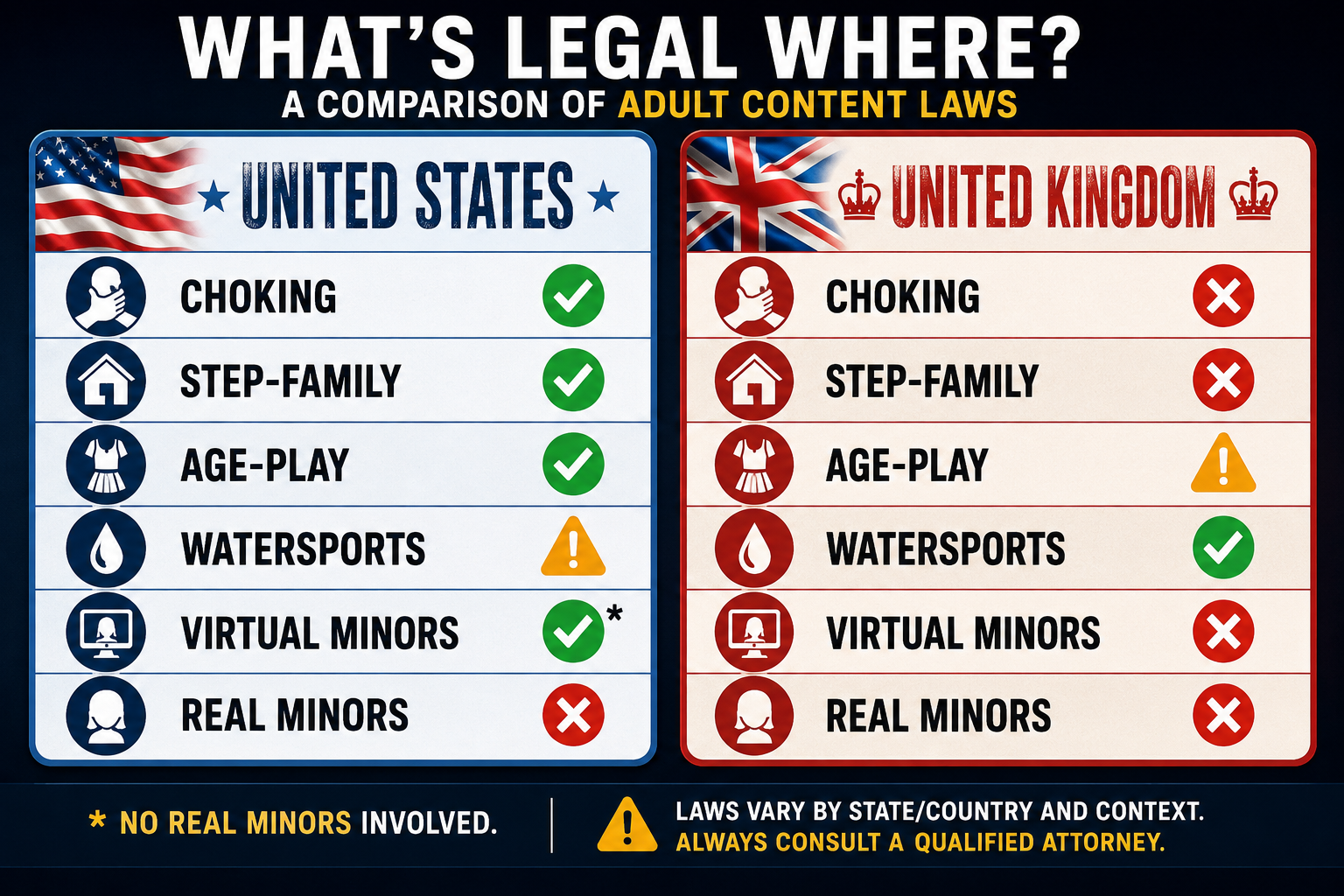
For example, something I learned while working at Bluebird Films: in Britain, you can pee on camera, but in America, that could land you in jail.
In fact, if you create adult content in the United States, there is a very good chance that what you produce technically falls under America’s obscenity laws. And obscenity is one of the very few categories of speech that receives absolutely no protection under the First Amendment.
Yes, you read that correctly. The same country that proudly proclaims itself the land of free speech has laws that can send adult producers to prison simply for creating consensual adult pornography. That’s because what so many don’t understand is that creating pornography is legal, while creating obscenity is not, and it’s your job to know the difference.
Meanwhile, across the Atlantic, the United Kingdom takes a completely different approach. Rather than banning pornography outright through obscenity laws, the UK instead regulates specific acts that it considers harmful or unacceptable.
The result is a strange legal paradox: some content that is perfectly legal in America is prohibited in the UK, while some acts allowed in the UK could potentially be prosecuted as obscene in the United States.
The American Approach: Pornography Is Legal… Until It Isn’t
Most Americans believe pornography is legal. Legally speaking, that isn’t entirely true. What is actually legal in the United States is non-obscene pornography.
The problem is that nobody can tell you exactly where the line between “pornography” and “obscenity” exists.
American obscenity law is primarily based on the 1973 Supreme Court case Miller v. California. Under what became known as the “Miller Test,” material can be declared obscene if:
- The average person, applying contemporary community standards, would find that the work appeals to prurient interests.
- The work depicts sexual conduct in a patently offensive way.
- The work lacks serious literary, artistic, political, or scientific value.
If all three elements are satisfied, the material is considered obscene and receives no constitutional protection.
That means producers, distributors, website operators, and even performers could theoretically face criminal prosecution. The penalties can be severe. Federal obscenity convictions have historically resulted in prison sentences, asset forfeiture, and substantial fines.
The biggest problem is that “community standards” are not universal.
What might be acceptable in Los Angeles, Las Vegas, or Miami could be considered obscene by a jury in rural Oklahoma, Alabama, or Utah. Since online content can be viewed anywhere in the country, adult producers have long argued that this creates enormous legal uncertainty.
As a result, virtually every mainstream adult producer in the United States operates under an unspoken understanding: as long as the government chooses not to prosecute, business continues.
In other words, much of the American adult industry exists in a legal gray area.
The UK Approach: Regulate Specific Acts
The United Kingdom took a very different route. Rather than focusing primarily on whether pornography itself is obscene, British regulators increasingly focus on the specific acts being depicted.
This has led to a list of sexual activities that can be restricted or prohibited in commercially produced pornography.
Over the years, UK regulations and classification standards have prohibited or heavily restricted content involving:
- Facesitting.
- Non-consensual themes.
- “Barely legal” age-play scenarios.
- Step-family incest roleplay.
- Choking and strangulation scenes.
- Content considered likely to encourage dangerous behavior.
Some of these restrictions have evolved over time, and enforcement mechanisms have changed, but the underlying philosophy remains largely the same: the government should determine which sexual acts may be commercially distributed.
Ironically, some acts that UK regulators (Ofcom) have restricted, such as consensual choking scenes, are commonly produced and distributed in the United States without specific legal prohibition.
At the same time, certain fetish content involving urination, often referred to as urolagnia or “watersports,” has historically been permitted in the UK under classification guidelines despite remaining potentially vulnerable to obscenity challenges in many parts of the United States.
Fantasy vs. Reality: If It’s Not Real, Is It Legal?
One of the biggest differences between American and British law involves fantasy scenarios. In the United States, the legal system generally focuses on whether a child was actually involved in producing the content.
In the landmark Supreme Court case Ashcroft v. Free Speech Coalition (2002), the Court struck down portions of the Child Pornography Prevention Act that attempted to ban so-called “virtual” child pornography. The Court ruled that because no real children were involved in creating the images, the material could not automatically be prohibited.
The decision established an important principle in American law: child pornography laws exist to prevent the sexual exploitation of real children. If no actual child was harmed, the material may still receive First Amendment protection unless it is deemed legally obscene under the Miller test.
This means that in the United States, adult performers portraying younger characters, engaging in age-play, or participating in school-themed roleplay is generally lawful so long as all performers are adults and no actual minors are involved.
The United Kingdom takes a much stricter approach.
British law does not focus solely on the performer’s actual age. Instead, courts may consider the overall impression created by the material. If content realistically depicts or strongly suggests that the performers are children, it can potentially violate laws relating to indecent images or prohibited material, even if every performer involved was over the age of eighteen.
In other words, American law typically asks, “Was a real child involved?” British law often asks, “Would a reasonable person believe this depicts a child?”
For adult content creators producing content for a global audience, this distinction can be extremely important. A fantasy scenario that may be perfectly legal to film in the United States could potentially expose a creator to criminal liability in the United Kingdom.
The question isn’t about which country is more permissive. Because in the end, you could be held to the standards of that country even if you live in another.
If your content involves consensual choking, age-play themes, schoolgirl roleplay, or step-family scenarios, the United States is generally more permissive.
But would that matter to the UK if its citizens watch it? No. It won’t, and it could get you in trouble in a foreign country, potentially restricting your attempt to travel outside the US.
American producers face a unique problem when creating adult content. There is no comprehensive list telling creators what is allowed and what is prohibited. Instead, they operate under a legal framework where almost any explicit sexual material could theoretically be challenged as obscene.
That uncertainty has existed for decades.
What This Means for OnlyFans Content Creators
For creators working on platforms like OnlyFans, Fansly, or their own websites, understanding these differences is critical. Many creators assume that because millions of people make adult content every day, the legal risks must be minimal.
But laws do not disappear simply because they are rarely enforced.
Creators who travel internationally, sell content globally, or work with studios in multiple countries should understand that what is perfectly acceptable in one jurisdiction may expose them to criminal liability in another.
The internet is global. Obscenity laws are not.
And when governments decide to enforce them, creators are often the ones caught in the middle.
Please note: I’m not a lawyer, nor do I play one on TV. Nothing in this article should be taken as legal advice. I’m simply sharing my personal experiences, research, and opinions. Laws vary widely depending on where you live and the specific facts of your situation. If you have questions about the legality of any content you create, you should always speak with a qualified attorney in your area. Every person’s situation is unique. If you aren’t sure about what to do, talk to a real attorney and get real avice specific to your situation. My experience working in the adult industry may not apply to you. So please if you are ever confused speak with a real lawyer.
About The Author