I’ve noticed a trend lately in adult industry press releases. More and more often, the release ends with something like, “Follow GIRLNAME at link.me/GIRLNAME,” or it points readers to a Linktree, Beacons, AllMyLinks, or another link-in-bio service.
There’s absolutely nothing wrong with using these services, and I use them myself. Link list landing pages are incredibly useful because they give fans one simple place to find your social profiles, subscription pages, stores, interviews, appearances, and whatever else you want to promote.
The problem isn’t the link page itself. The problem is building your public identity around a URL that belongs to somebody else.
Your Link Page Is Useful, but the URL Matters
I keep many of my own links at link.me/kelliroberts, and that works perfectly well for what I need it to do. What I don’t want, however, is for that third-party URL to become the permanent address printed in articles, press releases, interviews, business cards, social graphics, podcast descriptions, or anywhere else that may continue circulating for years.
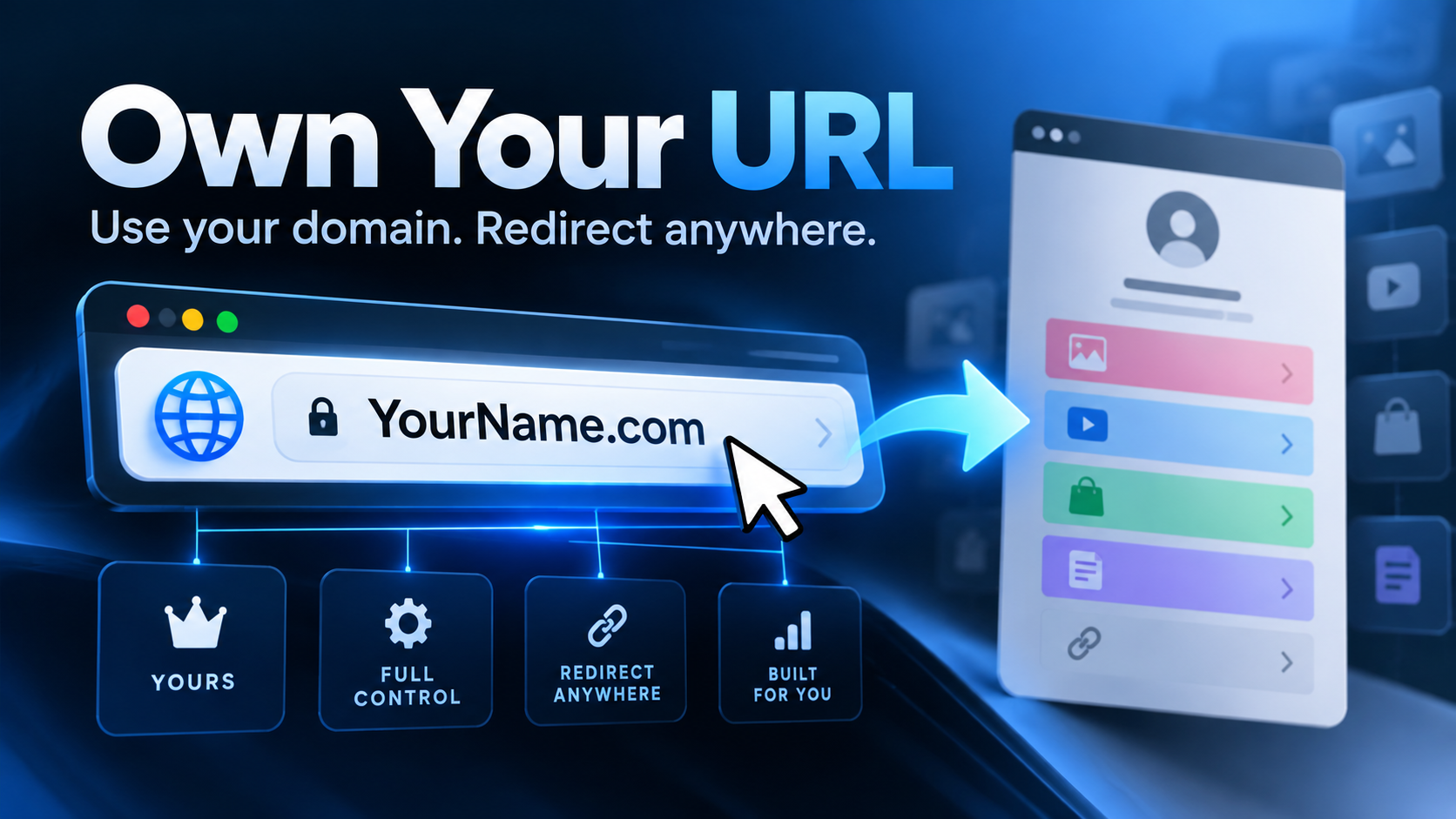
Instead, I can promote Kelli.info, which is a domain I control. Today I can have Kelli.info redirect visitors to my link.me page, and tomorrow I can redirect it somewhere completely different without changing the public-facing URL people already know.
That distinction may seem minor when everything is working properly. It becomes much more important the second something changes.
You’re Building Equity in Someone Else’s URL
Every time a publicist sends out a press release containing a Linktree, link.me, or similar third-party address, you’re effectively spending your publicity dollars promoting somebody else’s domain. The more press you receive, the more copies of that URL can spread across the internet.
An entertainment site may publish the release, a trade publication may copy it, and a blogger may reference it months later. Google may index those pages, someone may add the link to a database, and another journalist may discover that old article years later.
All of those references could continue sending people to the exact URL included in the original press release. If that URL is YourName.com, you control where those visitors go, but if it is ThirdPartyService.com/YourName, the third-party company controls the address.
That’s what creators need to think about before sending out press. You aren’t just sharing a link today, because you may be creating a permanent trail of links that will continue existing long after the original campaign is over.
| Promote a third-party URL | Promote your own domain | |
|---|---|---|
| Press release says | link.me/JaneDoe | JaneDoe.com |
| Current destination | link.me | link.me |
| Want to switch services? | Old links still point to link.me | Change one redirect |
| Account suspended? | Published links may become useless | Redirect somewhere else |
| Service shuts down? | You lose the destination | Your domain still works |
| Five-year-old articles | May contain obsolete links | Can still send visitors where you choose |
| Who controls the public URL? | Third-party company | You |
What Happens If You Need to Change Services?
Maybe everything is going great today, and you love your link-in-bio provider. You may have absolutely no intention of switching services, but that doesn’t mean you’ll feel the same way next year.
A service could change its pricing, features, or terms of service. It could introduce new restrictions, suspend your account, decide it no longer wants certain kinds of adult links, get sold to another company, or simply shut down.
External pressures can also affect the service. A payment processor, hosting provider, app store, advertising partner, or other business relationship could cause the service to change policies that affect adult creators.
You might even leave for a much simpler reason and discover another service you like better. The problem is that if everyone has been linking directly to ThirdPartyService.com/YourName, you can’t go back and edit every article, interview, press release, blog post, directory listing, and archived page already published about you.
Those links are already out there, and many of them may be impossible to change. If they point to a domain you own instead, switching services can be as simple as changing one redirect.
Yesterday, YourName.com could point to Linktree, and today it could point to link.me. Tomorrow it could point to your own website, while the public URL stays exactly the same.
This Matters Even More in the Adult Industry
Adult creators have additional reasons to think carefully about link control because platforms serving adult entertainers can face pressures that mainstream businesses rarely have to consider. Policies can change quickly, and companies that once welcomed adult creators can decide they no longer want to support them.
Accounts get flagged, adult-content rules change, and payment processors revise their requirements. Social networks can also begin blocking certain destinations, while hosting companies and third-party services may suddenly rewrite their acceptable-use policies.
Anyone who has worked in the adult industry long enough has watched some version of this cycle happen repeatedly. That is exactly why creators should control as much of their digital infrastructure as reasonably possible.
You may not control Instagram, X, TikTok, OnlyFans, or Linktree. You can, however, control your own domain name and use it as the permanent address connecting everything else.
Think of Your Domain as Your Digital Phone Number
Imagine running a business and printing somebody else’s phone number on every advertisement because they promise to forward the calls to you. That arrangement might work perfectly for years, but the moment they stop forwarding those calls, every advertisement you printed becomes a problem.
A personal domain works differently because you control where visitors are sent after they use it. You can change your destination while the public-facing address stays the same.
That flexibility is enormously valuable for anyone building a long-term brand. It is especially valuable when your name and links are appearing in press coverage you may not be able to edit later.
Press Releases Are Supposed to Have a Long Life
This is the part publicists and performers should really think about. A social media post may disappear from people’s feeds within hours, while a press release or article can remain online and searchable for years.
Search engines may continue surfacing an interview, announcement, award story, feature, or appearance notice long after the original publicity campaign has ended. That means the links included in a press release shouldn’t only work this week or this month.
Ideally, those links should still be useful years from now. If you’re spending hundreds or thousands of dollars on publicity over the course of your career, you may eventually build a large network of backlinks and references across the internet.
You want those links pointing somewhere you control. The more successful your publicity efforts become, the more important that ownership becomes.
You Don’t Even Need to Build a Website
People sometimes overcomplicate this idea because they hear “buy a domain” and assume I’m telling them to build a full website. You don’t need WordPress, a web designer, or a complicated hosting package just to take control of the URL you promote.
You can simply buy YourStageName.com, or another short, memorable domain tied to your brand. Then you can forward that domain to whichever link page you already use.
For example, JaneDoe.com could redirect to link.me/janedoe today. If Jane decides to switch to Linktree next year, she can simply change the redirect so JaneDoe.com points there instead.
Nothing published about Jane has to change because the public address remains JaneDoe.com. Her press links, business cards, old interviews, podcast descriptions, promotional graphics, and search results can all continue working.
She changes one redirect instead of trying to change the internet. That is the entire point.
What If Your Name Is Already Taken?
Many performers will discover that the exact .com version of their stage name is already unavailable. That doesn’t mean you should give up on owning a domain.
You can look for another memorable variation that still clearly belongs to your brand. You might use a different extension, add a short relevant word, use initials, or choose another simple branded variation. If YourName.com is taken, try TheYourName.com, YourNameOfficial.com, YourName.info, YourName.net, you-name.com, or yourname.love. There are many options in domain name variations. Just don’t pick anything obviously adult like .xxx or .porn.
The important part isn’t necessarily owning the perfect domain name. The important part is owning the domain you consistently promote and keeping control of it. Once you choose that domain, treat it as permanent infrastructure for your career. Services can come and go, but the address you own can stay with you.
Your Publicist Should Be Promoting Your Domain
This is where I think performers need to become more proactive with the people handling their publicity. If you’re paying someone to send out press releases, don’t let the only permanent URL in those releases belong to a third-party link service.
Your release can say, “Follow Jane Doe at JaneDoe.com,” and JaneDoe.com can redirect directly to her Linktree, link.me, Beacons page, or whatever service she currently prefers. Most readers won’t know or care that a redirect happened because they still arrive at the page Jane wants them to see.
The important difference is that Jane owns the address being published. If she changes services tomorrow, the articles that already exist don’t need to change with her.
This Is Really About Ownership
Creators spend enormous amounts of time building followings on platforms they don’t own. Instagram followers exist on Instagram, X followers exist on X, TikTok followers exist on TikTok, and OnlyFans subscribers exist inside OnlyFans.
Your link-in-bio page also exists on somebody else’s service, and that isn’t necessarily a bad thing. Third-party platforms are essential to doing business online, and there is no reason to stop using useful tools just because somebody else owns the platform.
What you should do is create an ownership layer wherever you reasonably can. Your domain name is one of the easiest and cheapest places to start.
Use Linktree, link.me, Beacons, AllMyLinks, or whatever service works best for you. I’m not telling creators to stop using any of them, because the issue isn’t the service itself.
I’m saying you shouldn’t make somebody else’s URL the permanent address of your career. Buy your own domain, control it, promote it, and then point it wherever you want.
Your platforms may change, your social accounts may change, and your subscription sites may change. Your link service may change too, but if you set things up correctly, the one address people use to find you never has to change at all.
About The Author