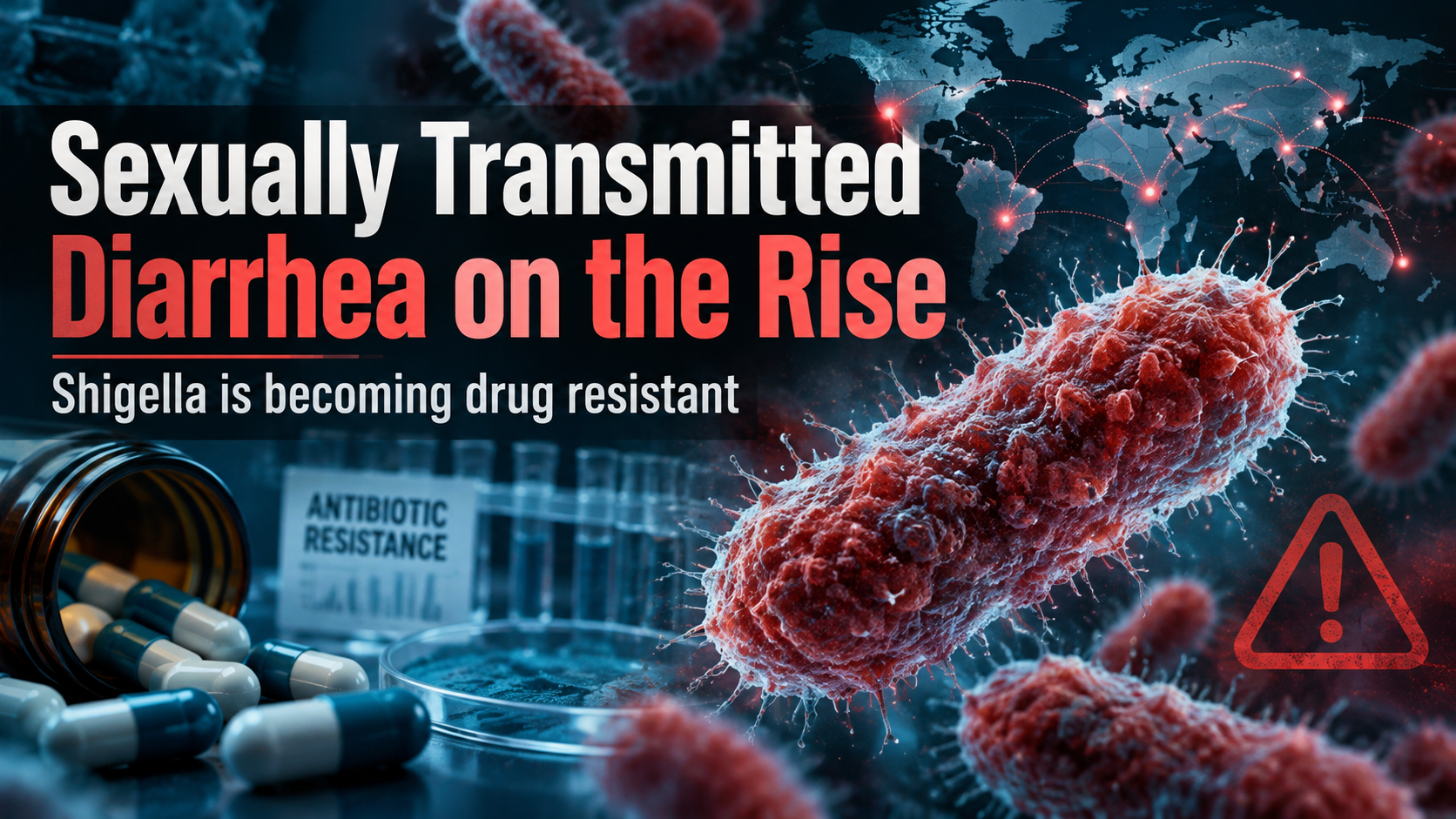
A bacterial infection traditionally associated with contaminated food, poor sanitation, and international travel is increasingly being spread through sexual contact. Now, scientists are warning that the bacteria responsible for the illness are evolving into drug-resistant strains that could become extremely difficult to treat.
The infection, known as shigellosis, is caused by Shigella bacteria and can trigger severe diarrhea, bloody stools, stomach cramps, fever, and dehydration. Although it isn’t generally considered a traditional sexually transmitted infection (STI), new research suggests sexual contact has become a major transmission route in certain communities, particularly among gay and bisexual men.
A study published July 8, 2026, in The Lancet Infectious Diseases found that sexually transmitted strains of Shigella spread substantially faster than strains associated with travel or other forms of transmission. Researchers also discovered that bacteria circulating through sexual networks were developing resistance to commonly prescribed antibiotics at an alarming rate.
“This disease has gone from being relatively treatable with off-the-shelf drugs to being close to untreatable over the course of the last decade or so,” said Professor Kate Baker, a geneticist at the University of Cambridge and senior author of the study.
How Shigella Became a Sexually Transmitted Infection
Shigella spreads through the fecal-oral route, meaning infection occurs when microscopic amounts of contaminated fecal matter enter someone’s mouth. This can happen through contaminated food, water, unwashed hands, or sexual activity involving exposure to fecal bacteria.
The bacteria are exceptionally contagious, with as few as 10 organisms capable of causing an infection. During sexual activity, transmission can occur through oral-anal contact, commonly known as rimming, as well as contaminated fingers, shared sex toys and contact with skin carrying bacteria from an infected person’s anal or genital area.
Importantly, penetration isn’t necessary for transmission, and a person doesn’t need to have visible fecal matter on their body to spread the infection. Someone who recently recovered from diarrhea may also continue shedding the bacteria after symptoms have disappeared.
Historically, shigellosis has been associated with young children, international travelers, and communities experiencing inadequate sanitation. However, scientists have documented sexually transmitted outbreaks among men who have sex with men since the 1970s, with sustained increases reported across North America, Europe and Australia during the past two decades.
“Many men who have sex with men are unaware of the serious and increasing risk posed by sexually transmitted Shigella,” Baker said.
New Research Reveals How Quickly the Infection Is Spreading
Researchers from the University of Cambridge and collaborating institutions analyzed 3,514 samples of Shigella sonnei collected across the United Kingdom between 2004 and early 2020. Using genetic sequencing and disease transmission modeling, they examined how different bacterial strains moved through sexual networks, domestic communities, and travel-associated cases.
The researchers identified 1,197 samples, approximately 34% of the total, as potentially associated with men who have sex with men. Another 36% were classified as other domestic cases, while nearly 30% were associated with international travel.
Between 2015 and 2020, strains circulating in presumed sexual transmission networks demonstrated a 15% relative growth advantage compared with travel-associated strains. The research also found that related bacterial samples from the presumed sexual transmission group were separated by an average of 117 kilometers, compared with approximately 46 kilometers among other domestic cases, over comparable evolutionary periods.
These findings suggest sexually transmitted strains are circulating more widely and through more numerous transmission chains than previously recognized. Researchers cautioned that their analysis relied partly on demographic information rather than confirmed sexual histories, meaning individual transmission routes couldn’t always be established.
More recent surveillance data reinforce concerns about the growing problem. According to the UK Health Security Agency, England recorded 2,560 diagnoses of potentially sexually acquired Shigella in 2025, compared with 2,318 in 2024 and 2,052 in 2023.
Antibiotic Resistance Is Making Shigella More Dangerous
While most healthy adults recover from shigellosis without antibiotics, severe infections can require medical intervention. Complications may include significant dehydration, bloodstream infections, and other potentially life-threatening conditions.
The growing prevalence of antibiotic-resistant strains creates additional challenges for physicians treating patients with serious infections.
In the Cambridge study, approximately 69% of Shigella samples associated with presumed sexual transmission networks carried resistance to at least one of three clinically important antibiotics: ciprofloxacin, azithromycin, or ceftriaxone. By comparison, resistance was identified in approximately 40% of other domestic samples and 49% of travel-associated samples.
The researchers also documented the emergence of strains resistant to multiple major antibiotics, leaving physicians with fewer reliable treatment options.
“This isn’t just one form of sexually transmissible diarrhea. This is multiple overlapping variants emerging that are all quickly becoming resistant to the drugs we use to treat them,” Baker said.
The problem isn’t confined to the United Kingdom.
In April 2026, the U.S. Centers for Disease Control and Prevention published findings showing that extensively drug-resistant Shigella increased from 0% of analyzed samples during 2011 through 2015 to 8.5% in 2023.
The CDC examined 16,788 bacterial isolates collected between 2011 and October 2023 and identified 510 that met its definition of extensively drug-resistant, or XDR, Shigella. Approximately 86% of patients with these resistant infections were men.
Under the CDC’s definition, XDR Shigella is resistant to five commonly recommended antibiotics, including azithromycin, ciprofloxacin, and ceftriaxone. No FDA-approved oral antibiotics currently treat infections caused by these extensively resistant strains, although specialists may consider other treatment approaches.
Not every Shigella infection is drug-resistant, and most cases remain treatable through supportive care. Nevertheless, the rise of XDR strains represents a significant public health concern.
Could Treatment for Other STIs Be Making Shigella Stronger?
One of the study’s most significant findings involves a phenomenon known as bystander antibiotic resistance, which occurs when antibiotics prescribed for one infection unintentionally encourage another organism to develop or retain resistance.
For example, someone receiving antibiotics for gonorrhea may also carry Shigella bacteria in their intestines. Even though the medication was prescribed to treat gonorrhea, the intestinal bacteria are exposed to the antibiotic, creating conditions in which resistant Shigella strains may survive and spread more successfully.
Researchers found evidence that resistance to azithromycin, an antibiotic previously used in combination therapy for gonorrhea, provided a particularly strong advantage to Shigella circulating in sexual networks before 2018.
When British gonorrhea treatment recommendations changed in 2018, removing routine azithromycin combination therapy, the researchers observed a corresponding decline in that resistance advantage. The findings support concerns that prescribing practices for one sexually transmitted infection can influence antibiotic resistance in entirely different bacteria.
The implications extend to sexual health programs involving frequent STI screening, repeated antibiotic treatment, and certain preventive antibiotic regimens. Researchers emphasized that understanding these interactions is essential to controlling antimicrobial resistance without compromising the appropriate treatment of other infections.
What This Means for Adult Performers and Sexually Active Individuals
Although the Cambridge study didn’t specifically examine adult entertainment performers or content creators, its findings have practical implications for anyone engaging in sexual activities involving oral-anal contact, multiple partners, or shared sex toys.
Unlike gonorrhea, chlamydia, and HIV, Shigella isn’t typically included in routine STI screening panels. Someone could therefore receive negative results on a standard sexual health screening while unknowingly carrying an intestinal infection capable of spreading during sexual activity.
This is especially relevant because symptoms can initially resemble ordinary food poisoning. A person experiencing diarrhea or stomach cramps might not immediately recognize that the illness could have been acquired during a sexual encounter.
Previous studies cited by Cambridge researchers suggest that as many as one-third of patients with sexually transmitted Shigella infections have required hospitalization, with average hospital stays of four to five days. Those findings concern particular studied patient groups and shouldn’t be interpreted as the hospitalization rate for every Shigella infection.
The researchers also noted that sexually transmitted Shigella has frequently been identified alongside other sexually transmitted infections, including HIV, gonorrhea, and chlamydia. Such associations don’t mean those infections cause shigellosis, but they reinforce the importance of evaluating patients for multiple conditions when appropriate.
For performers, producers, and independent creators, the research highlights the importance of postponing sexual activity when gastrointestinal symptoms occur. Routine STI testing remains important, but it doesn’t replace medical evaluation for suspected intestinal infections.
How to Prevent Sexually Transmitted Shigella
The CDC recommends several precautions to reduce the likelihood of transmitting Shigella during sexual activity.
- Avoid sex during and after diarrhea. Wait at least two weeks after diarrhea has completely stopped before resuming sexual activity, even when symptoms appear to have resolved.
- Wash thoroughly before and after sex. Clean hands, genitals, and the anal area with soap and water to reduce exposure to bacteria.
- Use condoms and dental dams. Barrier protection can reduce exposure during anal sex, oral sex, and oral-anal contact.
- Clean sex toys between uses. Wash toys thoroughly according to the manufacturer’s instructions, especially when sharing between partners.
- Consider gloves for anal contact. Latex gloves can help reduce exposure during activities involving fingers or hands.
- Tell your doctor about relevant sexual activity. If you’re experiencing severe or prolonged diarrhea, mentioning recent sexual contact can help clinicians determine whether testing for Shigella is appropriate.
Anyone experiencing bloody diarrhea, signs of dehydration, high fever or worsening symptoms should seek medical attention. Physicians may request stool testing and antibiotic susceptibility testing, particularly when a drug-resistant infection is suspected.
Antibiotics aren’t necessary for every case, and inappropriate use can contribute to further resistance. Treatment decisions should be based on illness severity and, when possible, laboratory findings.
Researchers Warn the Problem Could Get Worse
The Cambridge researchers believe sexually transmitted, drug-resistant shigellosis could continue expanding without more targeted prevention measures. They argue that conventional public health approaches focusing primarily on handwashing, food safety and travel precautions aren’t sufficient to address transmission occurring during sexual activity.
The research calls for improved sexual health education, better surveillance, treatment guidelines informed by antibiotic resistance and the eventual development of effective vaccines.
“Sexually transmissible shigellosis needs to be treated as a distinct public health threat, requiring different surveillance, prevention, and treatment strategies,” Baker said.
For sexually active individuals, the most immediate concern is awareness. An illness that might initially be dismissed as food poisoning can be sexually transmitted, can remain contagious after symptoms subside and, in a growing number of cases, may be resistant to the antibiotics traditionally used to treat it.
About The Author