Can you still post nudity on X? The answer is more complicated than you think.
Instagram has suspended millions of accounts this year. YouTube has now started banning any account (even safe-for-work ones) that belongs to adult content creators (mostly those who have their OF links or Linktree/LinkMe links in their profiles) for “Nudity,” even if the YouTube account in question has no nudity or anything remotely sexual.
But we still have X (Twitter), right?
Well, not really.
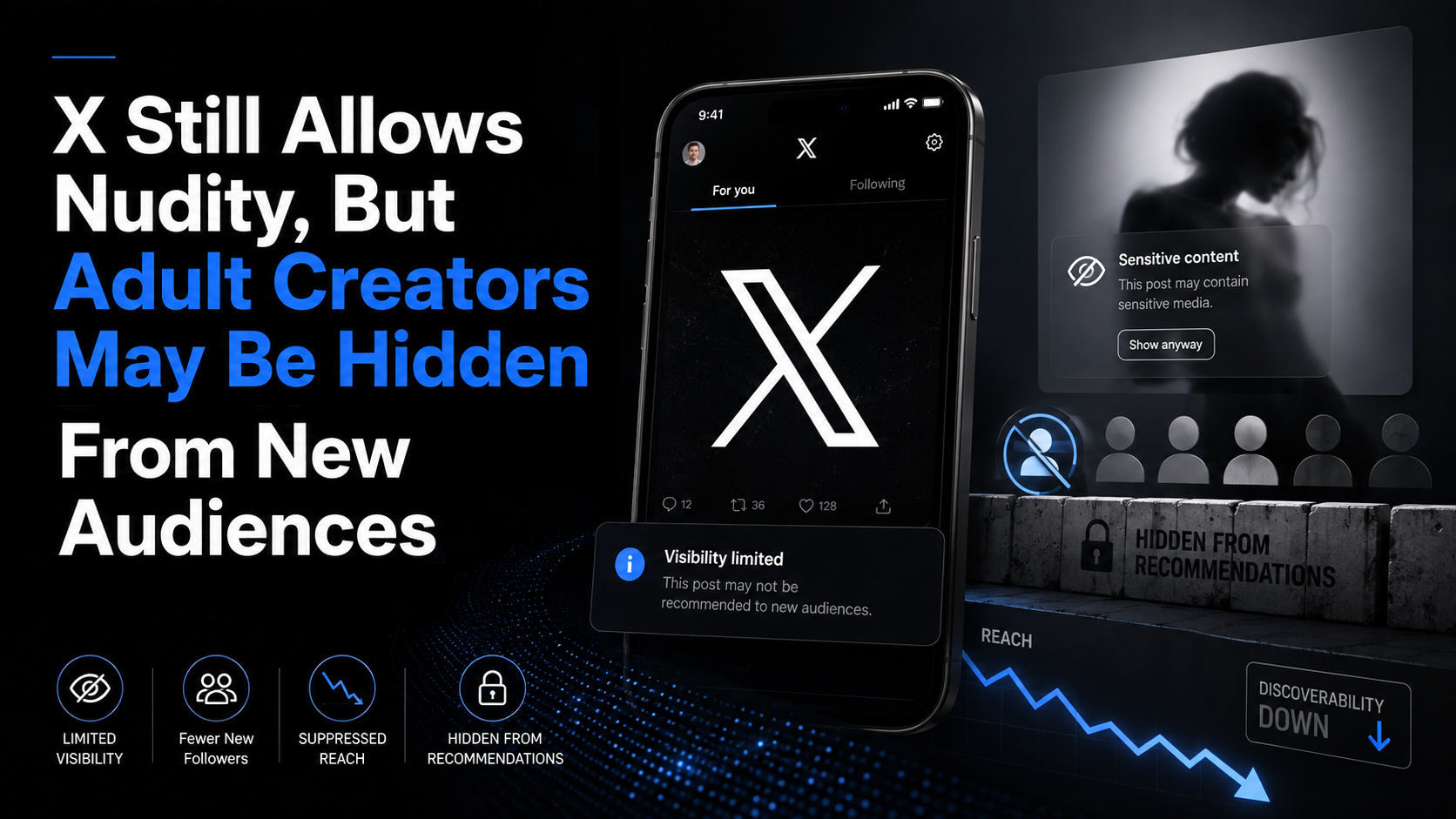
Adult content creators have noticed something interesting happening over the last few months. They are still getting likes and comments from their current followers, but their content isn’t getting pushed to new people (who don’t already follow them).
This was only speculation … until now. We now have verified data from the platform itself. On August 13, 2026, the company published production ranking parameters for the content you post and what makes it rank in a person’s “For You Feed”.
The final score is essentially a weighted sum of these predicted probabilities. Higher predicted likelihood of valuable actions boosts ranking; predicted negative actions strongly demote it. Note that the weights multiply probabilities, not raw engagement counts after the fact—so relative multipliers (e.g., “40× a like”) describe the coefficient scale, not a direct points system where one real share instantly equals 40 likes.
Notice it says “not a direct point system”. This is important because it’s telling us that the weight of an active is variable and that comes into play with the type of content posted, and that’s important for an adult content creator.
If you were to read the rankings at face value, you would think that a person who tweets something that gets a lot of likes, shares, and comments would then have that tweet pushed out to more and more people.
But adult content creators began to see that wasn’t the case for them.
Their post might be getting likes and comments from their current followers, but their tweets weren’t being seen by anyone who wasn’t already following them.
But why?
First, we have to see that there are two rule sets (negative and positive). The first gives your tweet a boost, while the second restricts visibility.
|
Predicted action
|
Weight
|
Relative to a like (~0.5)
|
|---|---|---|
|
Share via copy link
|
20.0
|
~40×
|
|
Reply (original post from mutual follow, with boost)
|
up to ~20.0
|
~40×
|
|
Reply (normal)
|
5.0
|
~10×
|
|
Quote
|
5.0
|
~10×
|
|
Share via DM
|
5.0
|
~10×
|
|
Follow author
|
4.0
|
~8×
|
|
Share (generic)
|
2.0
|
~4×
|
|
Repost
|
1.0
|
~2×
|
|
Favorite / like
|
0.5
|
1×
|
|
Click (expand/open post)
|
0.4
|
~0.8×
|
|
Open link
|
0.2
|
~0.4×
|
|
Photo expand / video open/video quality view / quoted-post click
|
~0.05 each
|
~0.1×
|
|
Continuous dwell time
|
very small (e.g., 0.004 per unit)
|
tiny
|
Looking at this information, you can see that just liking a post isn’t that big of a deal (like many people think).
Share-via-copy-link is the strongest positive coefficient in the published parameters. Replies (especially conversational ones involving mutual follows or author engagement in older models) and other meaningful shares also rank highly. Likes are among the weaker positive signals.
So while likes matter, other things often matter more.
Now let’s look at the things that really hurt your tweets.
|
Predicted action
|
Weight
|
Rough relative impact vs. like
|
|---|---|---|
|
Report
|
−234.0
|
Extremely large negative
|
|
Mute author
|
−58.8
|
Very large negative
|
|
Not interested
|
−43.2
|
Large negative
|
|
Block author
|
−31.2
|
Large negative
|
|
Not dwelled
|
−0.02
|
Minor
|
Negative predictions carry much larger magnitude weights than most positives because such actions are rarer and more informative about content a user dislikes. A high predicted chance of report/mute/block/“not interested” can heavily suppress a post.
Other important factors that affect reach …
Author diversity: Subsequent posts from the same author in a user’s candidate pool are discounted (exponential decay), so rapid posting of many items can limit distribution of later ones.
Out-of-network discount: Posts from accounts the viewer does not follow typically receive a multiplier below 1 (commonly referenced around 0.75 in analyses).
➡️ External links: Often reduced in candidate selection or overall distribution (to keep users on-platform), even though a predicted “open link” action itself has a small positive weight. Putting links in replies is a common workaround discussed by creators.
Content type and other heuristics: Native video, higher dwell time, and conversation-driving posts tend to perform better in practice. Filters for spam, safety labels, recency windows (posts older than ~48 hours are commonly filtered from this pipeline), and account-level signals also apply.
Older public weights (from the 2023 open-sourcing of the Heavy Ranker) emphasized replies even more extremely in some configurations (e.g., author-replied-to reply signals), and many guides still reference those alongside the 2026 parameters.
So again, at face value, one would assume if they post a tweet that gets a lot of likes, comments, and shares, they would be good. Right?
Well no. Because there is something else buried deep in the code.
For everyone else, content that people are predicted to share (especially by copying the link), reply to, quote, or follow the author from ranks strongly; content predicted to trigger reports, mutes, blocks, or “not interested” is heavily suppressed.
But for adult content creators, those things have an override. After all other weights are factored in, both negative and positive content labeled as “NSFW” is generally excluded from For You recommendations to non-followers. This effectively sets algorithmic discovery/reach to zero (or near-zero) outside the author’s existing followers.
It is not a soft ranking penalty or reduced weight in the main scoring formula. Instead, posts (or accounts) carrying certain adult-content labels are filtered out of the candidate pool used for broad recommendations:
Content is broken down into three categories:
- NsfwHighRecall → “may” (catches more)
- NsfwHighPrecision → “likely”
- NsfwNearPerfect → near-certainty / strongest automated signal
It’s important you understand what these three things mean because it’s the only way to ensure your tweets aren’t tagged with them if you want your tweets to start getting amplified again.
NsfwHighRecallOfficial: “Account detected by automated systems as one that may post content subject to X’s Adult Content policy.” This is the broader, more sensitive detection (“high recall” means it catches more potential cases, including borderline or less-certain ones, at the cost of more possible false positives). Effect: The account’s posts are hidden from recommendations to non-followers.
NsfwHighPrecisionOfficial: “Account detected by automated systems as likely to post content subject to X’s Adult Content policy.” This is a higher-confidence detection (“high precision” means fewer false positives; the system is more certain the account posts adult content). Effect: The account’s posts are hidden from recommendations to non-followers.
NsfwNearPerfectOfficial: “Account detected by automated systems as one that may post content subject to X’s Adult Content policy.” In practice and supporting analyses of the classifier, this is the strongest/near-certainty level (often triggered when media scores extremely high, e.g., >0.99 confidence from the detection model). Effect: The account’s posts are hidden from recommendations to non-followers.
Notice all three have the exact same effect: “the account’s posts are hidden from recommendations to non-followers.” This suggests they once had different weights. But that is no longer the case. Now, no matter which of the three you are, your tweets aren’t getting shown to non-followers.
Per Tweet or Per Account?
The question is, do they suppress your non-adult tweets if you are an adult account? That took a bit of further digging to find the answer.
X does apply account-level flags (NsfwHighRecall / “maybe” adult content account, NsfwHighPrecision / “likely,” NsfwNearPerfect), and they also apply them directly to your avatar/banner images.
Once an account has these, all posts from that account (including non-explicit ones) are generally hidden from non-follower recommendations. Discovery/reach outside existing followers drops to essentially zero.
Repeated flagging of individual posts for sensitive/adult media can trigger or reinforce account-level labeling/auto-labeling, so the restriction becomes permanent or long-lasting for the whole account.
In other words, a single explicit post can be restricted on its own, but persistent adult content often escalates to account-wide restrictions that affect everything the account posts.
How can you tell if your account is fully restricted?
Public web or X searches will not reliably reveal private safety/NSFW labels, as they are not exposed externally. No matter what a 3rd party app may tell you, it can’t really be fully reliable. You have to get the information directly from X.
Go directly to this URL while logged into your X account: https://x.com/i/under_the_hood
That is the official “Under the Hood” transparency page.
It is currently in a pilot / limited rollout (started around August 13, 2026, alongside the algorithm open-sourcing).
- Eligibility is restricted to: Accounts that are at least 1 year old
- Accounts that posted 10 or more times in the previous month
- A randomized test group among those eligible accounts
Many users still don’t have access. If you see a message that you don’t have access or the page is limited, there is currently no way to request or force inclusion.
If you have it, you’ll see something like this and click the DOWNLOAD button.
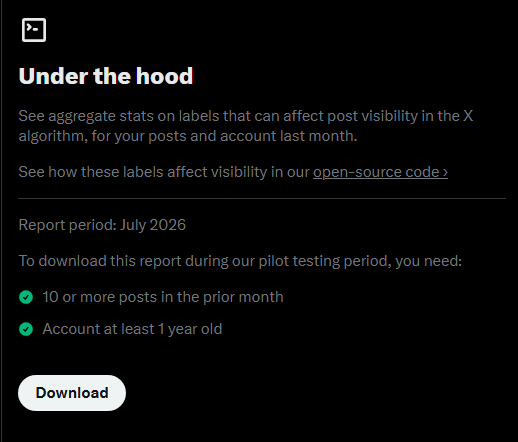
Once you click the download button, you’ll get this .json file. Open it in a text editor. You don’t need fancy software to read it. Just look, and you’ll see.
In my case …
“label”: “NSFW_ADMIN”,
“about”: “Post written by an account with an NsfwAdmin user label, where the account was identified in response to a user report as primarily posting content subject to X’s Adult Content or Violent Content policies.”,
“effect”: “Post shown behind content warning, hidden from recommendations to non-followers and from underage users, users without a stated age, and logged-out users.”,
“posts”: “102”,
“totalPostsInMonth”: “102”,
“percentageOfPosts”: “100.00%”
I’ve posted 102 posts in the last 31 days, and 100% of them have been flagged. As a result, my reach is limited, and it flat-out tells me so.
“Post shown behind content warning, hidden from recommendations to non-followers and from underage users, users without a stated age, and logged out users.”
How to fix the NSFW flags?
I know that everyone is curious whether you can get out of the NSFW jail if your account is flagged.
I have 1 out of 102 posts that were NSFW in the past 31 days. ONE POST, and it triggered a full account NSFW flag.
But fixing it won’t be easy. First, you must remove all NSFW posts. If you’ve had your account for a while, this won’t be easy, so you’ll need to use a 3rd-party site like tweetdelete.net.
Then, once all adult content is removed, you have to examine your avatar and header image and make sure it’s not remotely risky. If it is, change it. You want a super SFW avatar and header banner.
Now wait 31 days. The day AFTER the 31 days have passed, submit a formal review/appeal through the X Help Center asking for the NSFWadmin label to be lifted, stating that the account no longer primarily posts adult content.
Will it work? Maybe. Know that it could take days or even weeks for them to review your request. And you should only submit it after you’ve fully cleaned your profile and waited the full 31 days.
About The Author