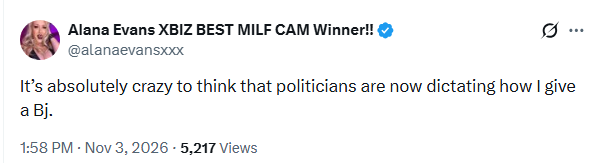
Alana Evans recently tweeted about a new law that makes her gagging on a guy’s junk illegal. Many thought she was joking. She wasn’t. It’s a very real law that goes into effect on November 6th.
And even if you don’t live in England, it still affects you in many ways (if you make content that is put on the Internet). But let me explain.
A law targeting pornography depicting strangulation and suffocation is prompting restrictions on facesitting, breast smothering, chest sitting, and other fetish categories. For creators reading the legislation, the obvious question is why platforms are banning categories Parliament never specifically named.
The answer involves both what suffocation means and how platforms translate legal obligations into moderation rules. Some content sold under those labels could fall within the new offenses. A blanket category ban, however, can also sweep up material that does not meet the legal test.
That distinction matters. A platform’s prohibited-content list tells creators what they can sell through that service. It does not, by itself, establish that every removed clip is criminal.
| Banned category | What it covers | Possession penalty | Publication penalty |
|---|---|---|---|
| Strangulation or suffocation | Pornography depicting one person strangling or suffocating another person | Up to 2 years | Up to 5 years |
| Incest between certain relatives | Pornography depicting penetrative sexual activity between certain relatives | Up to 2 years | Up to 5 years |
| Pretending to be related | Pornography depicting penetrative sexual activity where people are pretending to be certain relatives | Up to 2 years | Up to 5 years |
| Adults role-playing as children under 16 | Pornography depicting sexual activity where a person is pretending to be under 16 | Up to 3 years | Up to 5 years |
| Certain step or foster-family child role-play scenarios | Pornography showing step or foster-relations where one person is pretending to be under 18 | Depends on the specific depiction, but it is covered by the new offenses | Up to 5 years |
The Law Targets Depictions, Not a List of Fetish Categories
Section 104 of the Crime and Policing Act 2026 creates offenses involving possession and publication of certain pornographic images portraying one person strangling or suffocating another. The relevant provisions take effect in England and Wales on November 6, 2026. Although platforms are issuing notices covering UK users and creators, that operational scope should not be confused with identical commencement across every UK jurisdiction.
The statutory test requires an explicit and realistic portrayal, with people a reasonable viewer would think are real. Section 104 does not name facesitting, breast smothering, jeans facesitting or trampling as prohibited genres.
| Illegal from Nov. 6 | Included? |
|---|---|
| Choking porn | Yes |
| Suffocation porn | Yes |
| Porn showing sex between relatives | Yes |
| Incest role-play | Yes |
| Adults pretending to be children under 16 | Yes |
| Some step/foster-family role-play involving underage portrayal | Yes |
An unnamed activity can nevertheless fall within a generally worded offense. Equally, its absence from the statute does not give a platform authority to declare every depiction in that category unlawful. The question is what the particular material portrays.
Suffocation Extends Beyond Choking
The Ministry of Justice’s October 16 guidance explains the connection. Strangulation generally involves pressure to the neck. Suffocation can involve depriving someone of air in a way that affects breathing, including covering the mouth and nose or compressing the chest.
These are the government’s explanations of terms the legislation leaves undefined. Whether an image depicts suffocation remains a factual question for a court.
That interpretation helps explain why smothering and certain sitting or compression scenarios are attracting scrutiny. A scene does not need a hand around someone’s throat to raise a suffocation issue. Depending on what it depicts, pressure or obstruction elsewhere could bring it within the same legal provision.
But proximity to someone’s face, contact with their chest or membership in a fetish category does not settle that question. Treating those features as automatic proof would replace the statutory test with assumptions about the genre.
iWantClips Has Announced Category-Level Restrictions
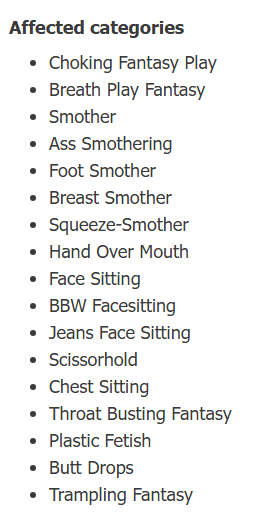
The iWantClips notice supplied for this article lists 17 affected categories, including Choking Fantasy Play, Breath Play Fantasy, Breast Smother, Hand Over Mouth, Face Sitting, BBW Facesitting, Jeans Face Sitting, Scissorhold, Chest Sitting, Plastic Fetish, Butt Drops and Trampling Fantasy.
Its public FAQ describes two different consequences. Affected content will be removed from UK artists’ stores before November 6. Artists outside the UK will retain their content, but UK fans will lose access to it. The restrictions also cover UK customers’ access to affected previous purchases.
For a UK creator, removal from a store can therefore affect sales to overseas customers as well. For an overseas creator, the announced restriction concerns UK customers’ access.
The list shows how much broader a platform’s operational rule can look than the language of the legislation. Several categories have an understandable potential connection to obstruction or compression. Others, such as a broad plastic fetish or trampling category, require substantially more information before anyone could assess an individual clip.
The notice does not establish that every item filed under those labels depicts suffocation. Nor does it explain how it will distinguish borderline material from material that clearly meets the legal test.
For now, this only matters if you are a creator from the UK or have customers in the UK who buy your content. But if Visa and Mastercard have their way (and we know they always get what they want), it’s likely all of these things will be banned in the US very soon. Not by law, but by merchant processors. That’s an important difference.
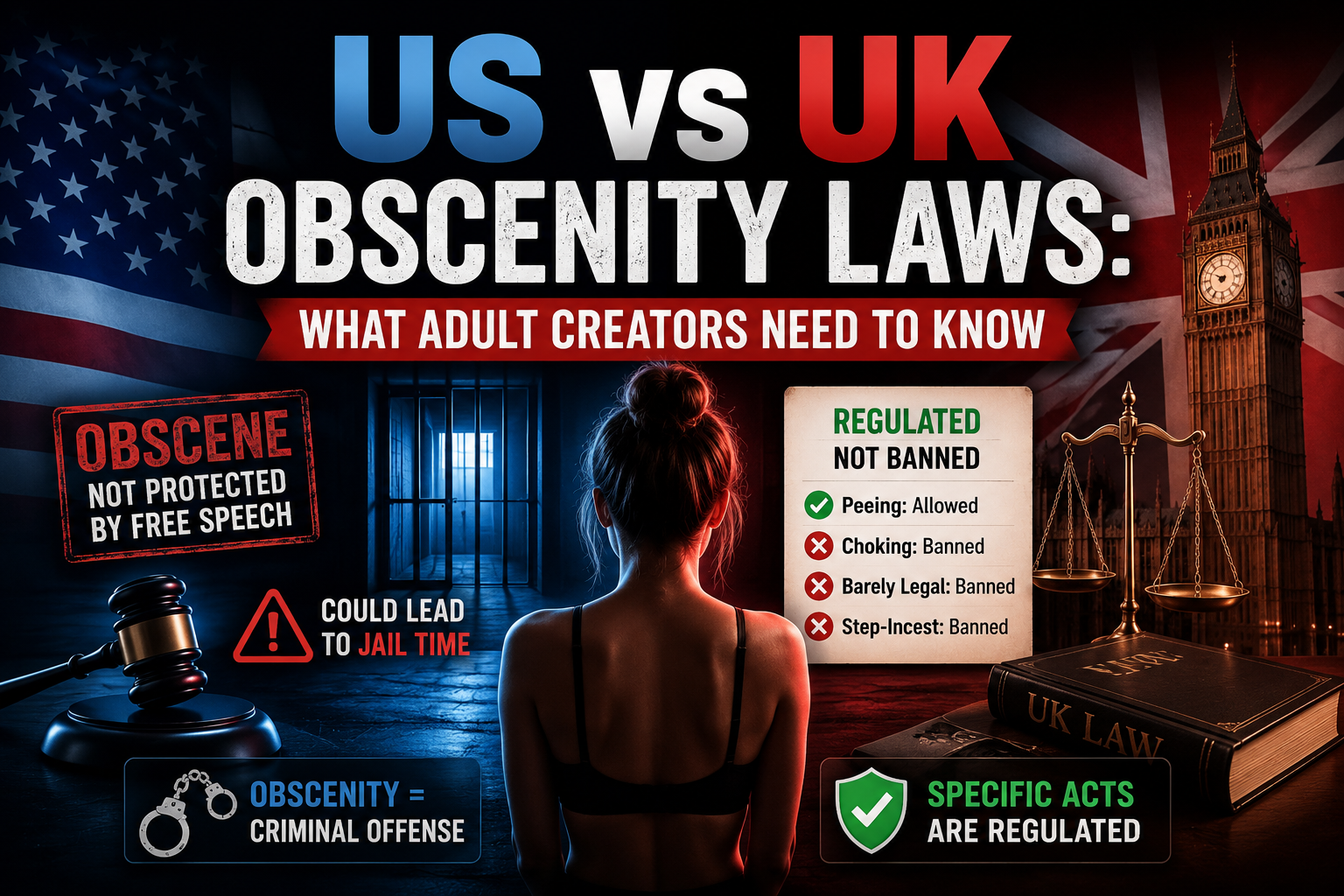
In the UK, it’s a criminal act, a jailable offense.
That wouldn’t be the case in the US. Credit card companies just simply won’t allow you to process payments for that type of content.
MintStars Has Also Announced Changes
In an October 29 announcement, MintStars said it was changing its terms to comply with new legislation. The visible thread identifies realistic sexual content depicting strangulation or suffocation, certain relatives engaging in sexual activity, and people appearing or roleplaying as under 16 among the affected material.
That announcement supports reporting that MintStars is responding to the new law. The supplied excerpt does not establish that it has adopted iWantClips’ same 17-category list or an equivalent blanket facesitting ban.
Keeping those claims separate strengthens the wider argument. The evidence already shows a significant platform response without assuming every service enforces identical restrictions.
Why Platform Rules Can Reach Further
The likely explanation for category-wide restrictions is risk management. That is an inference from the breadth of the announced rules, rather than a confirmed account of either platform’s internal decision-making.
Applying the legal test to individual scenes requires judgment. Moderators would need to distinguish between a depiction of suffocation and a similar scene that does not portray it. A category filter offers a simpler administrative rule, even if it catches material outside the offense.
There is also a practical difference between defending an individual work and operating a large catalog. A creator may believe a particular clip falls outside the law. A platform may decide not to host the wider category in which that clip appears.
Section 104 also makes the new offenses priority offenses under the Online Safety Act. That adds a regulatory context to moderation decisions, but it does not convert a platform’s category labels into statutory definitions
The result can be a wider commercial restriction than the criminal law itself requires. Explaining that possibility does not establish that any particular removed clip is lawful, or that a platform has deliberately misrepresented its obligations. It identifies the gap between evaluating an image and excluding a genre.
Why Blocking UK Viewers Does Not Resolve Every Issue
The law addresses possession as well as publication. Ministry of Justice guidance says possession can include custody or control of material stored on devices, in personal accounts or in the cloud. It also explains that possession and publication can continue after an image was originally obtained or uploaded.
Restricting who can view something therefore addresses a different issue from whether someone continues to possess it. That helps explain why iWantClips distinguishes between removing affected content from UK creators’ stores and blocking UK access to overseas creators’ material.
There are statutory defenses, including a qualified defense for someone possessing an image of an act in which they directly participated. The explanatory notes also describe a narrower participant defense for publication to other participants. These do not amount to a general permission to sell covered material commercially.
The existence of possession offenses still does not mean every clip in a platform’s affected categories must legally be deleted. That conclusion depends on whether the material falls within the offense and whether an applicable defense or exclusion applies.
The Chilling Effect Is Part of the Story
A creator does not need to be prosecuted to experience a restriction on their work. Losing a sales channel, having a catalog category excluded, or deciding against producing uncertain material can all affect what reaches an audience.
Those potential consequences deserve scrutiny alongside the law’s wording. Where platforms apply broad exclusions, creators need clear explanations of whether a removal reflects an assessment of the individual work, a category-wide policy, or a decision to avoid unresolved legal risk.
It would be inaccurate to describe Section 104 as expressly banning every facesitting video. It would be equally incomplete to discuss the legislation without examining the broader platform restrictions being introduced in response.
The issue is how a prohibition on particular depictions becomes a commercial ban on whole categories. The law supplies the legal test. Platforms decide how to enforce their obligations, and creators bear the consequences.
So what it comes down to is this. Yes, a country you don’t live in can make a new law that directly affects you and the content you make.
That’s why voting matters: the people in power influence these decisions.
Don’t want someone to tell you that you can’t gag on a guy’s junk in your latest video? Then make your voice heard at the polls.
Because at this point, I don’t know what else we can do. The platforms we sell our content on just don’t want to take the risk of getting in legal trouble or losing their credit card processing.
So it’s just easier for them to ban it outright.
About The Author