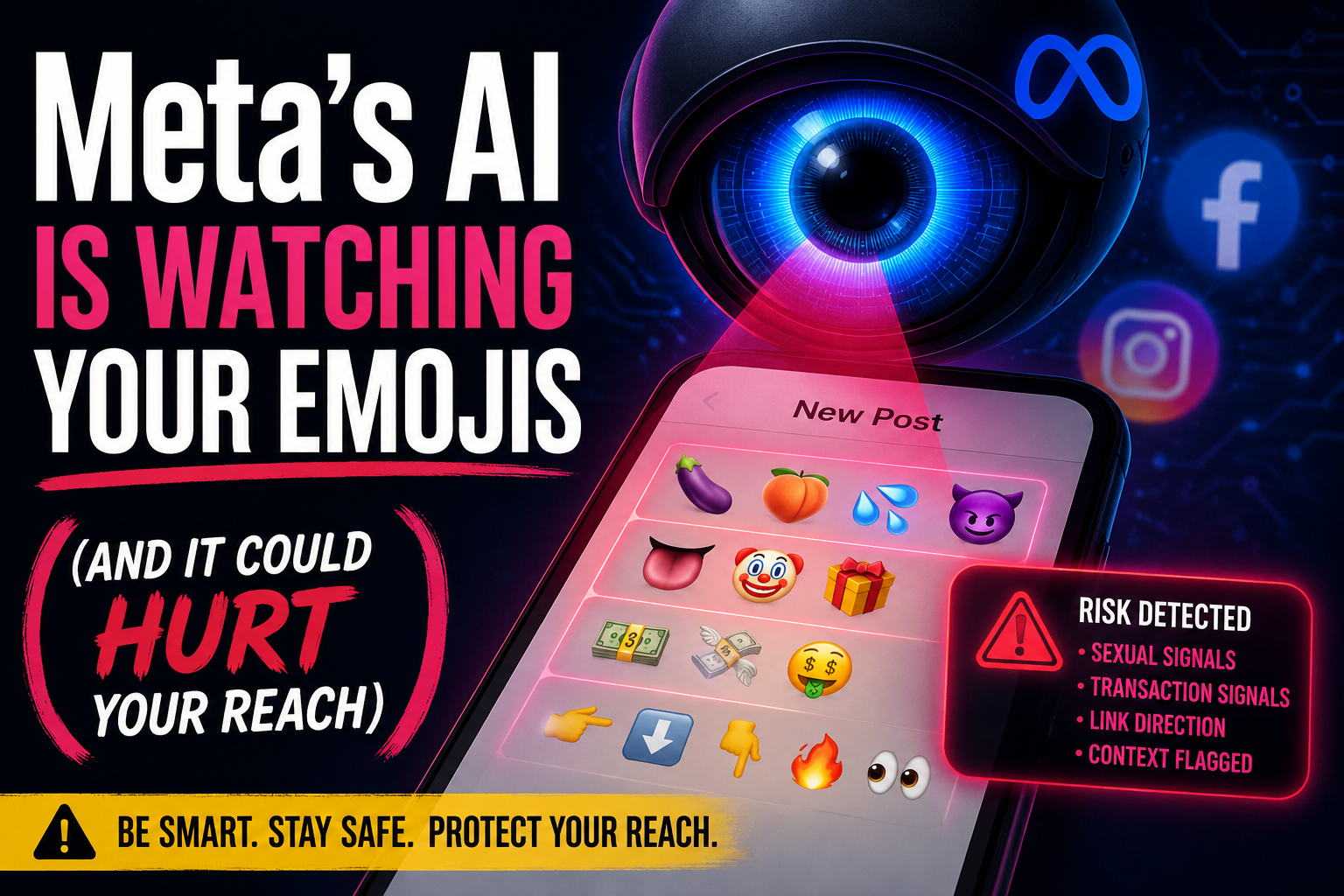
Can an emoji be overly sexual? Well, according to Meta (the parent company of Facebook and Instagram), it can.
Most content creators worry about links. Some worry about hashtags. Others worry about what words they use in their captions.
But what if I told you that a simple emoji could be helping Meta’s automated moderation systems decide whether your content gets flagged?
It sounds ridiculous, but it isn’t.
As adult content creators, we already know that Instagram and Facebook rely heavily on AI and automated classifiers to review content. There simply aren’t enough human moderators in the world to manually review the billions of posts uploaded every day. Instead, Meta uses artificial intelligence to analyze everything from your photos and videos to your captions, comments, links, and yes… even your emojis.
And according to multiple creator reports and moderation researchers, certain emojis appear to carry more risk than others when combined with adult-themed content.
An emoji by itself is usually harmless. The problem happens when Meta’s systems begin looking at patterns.
For example, a peach emoji isn’t necessarily a problem. Neither is a water droplet emoji. But when those emojis appear on an account that regularly posts lingerie photos, links to subscription platforms, or content that Meta already considers borderline adult, they may contribute to a larger moderation score.
Think of it like a risk assessment. One signal might not matter. Ten signals combined might.
Meta’s systems don’t just look at one thing. They evaluate hundreds of different factors simultaneously.
The Emojis Creators Report Being Most Problematic
While Meta has never published an official banned emoji list, creators have repeatedly reported issues when using emojis commonly associated with sexual content.
Examples include:
🍆 Eggplant
💦 Water droplets
🍑 Peach
😈 Smiling devil
These emojis have become internet shorthand for sexual themes, which makes them easy targets for automated classifiers.
Again, using one doesn’t automatically mean your account will be punished.
The concern is when they’re combined with other adult signals.
Suggestive Emojis Can Also Trigger Attention
Other emojis that appear to attract scrutiny include:
👅 Tongue
🍑 Peach
🤡 Clown
The tongue emoji in particular is frequently associated with sexual content and suggestive captions.
When paired with revealing imagery or adult marketing language, it may increase the likelihood that a post receives additional scrutiny.
The Money Emoji Problem
This is where many OnlyFans creators accidentally get themselves into trouble. Meta has become increasingly aggressive toward content that appears to combine adult themes with financial transactions.
Creators have reported issues when using:
💵 Money
💸 Flying money
🤑 Money face
🎁 Gift
Why?
Because Meta’s systems may interpret these as transaction signals.
If you’re already posting suggestive content and then add multiple money-related emojis, the platform may view the post as promoting paid adult services.
That’s not a risk worth taking.
Be Careful With Directional Emojis
Many creators love using arrows and pointing emojis to direct followers toward a link in their bio. Unfortunately, Meta appears to pay attention to those too.
Examples include:
👇
⬇️
👉
💡
These emojis become particularly risky when they’re used next to phrases like:
“Link in bio”
“See more”
“Exclusive content”
“Subscribe here”
The AI isn’t just looking at the emoji. It’s looking at the entire context surrounding it.
Context Matters More Than Anything
Some emojis are generally harmless but can become problematic when paired with adult content.
Examples include:
🔥 Fire
👀 Eyes
On a cooking account, these mean almost nothing. On a creator account promoting lingerie photos or subscription content, they can contribute to an entirely different interpretation.
This is one of the reasons moderation can feel so inconsistent. The same emoji may be completely fine on one account and problematic on another.
What Creators Should Do Instead
The goal isn’t to stop using emojis altogether.
The goal is to understand that every element of a post contributes to how Meta’s AI interprets it.
A safer approach is to:
- Use emojis sparingly
- Avoid obvious sexual emoji combinations
- Limit money-related emojis
- Avoid stacking multiple risk signals together
- Focus on personality and storytelling instead of coded adult language
Think of your account like a credit score. One negative signal won’t destroy you. But enough negative signals stacked together can cause problems.
What Is Reach, Anyway?
Reach is the number of unique people who see your content.
If Instagram shows your Reel to 1,000 different people, your reach is 1,000. If one person watches it ten times, that still counts as one person reached.
For creators, reach is one of the most important metrics on the platform because reach is what fills the top of your funnel.
Think of it this way:
- Reach creates profile visits.
- Profile visits create followers.
- Followers become fans.
- Fans become subscribers.
- Subscribers become income.
When your reach shrinks, every step of that process shrinks with it.
A creator might not notice a drop in subscribers immediately, but if Instagram stops showing their content to new people, the effects usually appear weeks or months later. Fewer eyes on your content means fewer opportunities to attract future customers.
That’s why creators obsess over reach. It’s often the difference between an account that’s growing and an account that’s standing still.
Why Meta Pays Attention to Emoji Usage
Meta isn’t reading emojis because they’re cute. The company uses them as signals to help its AI understand what content is about and how people are reacting to it.
Instagram and Facebook are no longer moderated primarily by people. They’re moderated by machines. Those machines don’t understand humor, sarcasm, flirtation, or context the way humans do.
Instead, they rely on patterns. And emojis are part of those patterns.
The company uses them as signals to help its AI understand what content is about and how people are reacting to it.
For example:
🔥 often signals excitement or attraction.
😍 usually indicates admiration or desire.
💰 may suggest financial topics.
🍆 and 🍑 are commonly used as sexual references.
The AI doesn’t just look at the image or video. It also analyzes captions, comments, hashtags, and engagement patterns to determine who should see the content and whether it complies with platform policies.
In other words, your emojis become metadata.
As adult content creators, understanding how these systems work gives you an advantage. You don’t have to agree with the rules. You don’t even have to like them.
But if you want to maximize your reach, protect your account, and avoid unnecessary moderation issues, it’s important to understand how Meta’s AI may be interpreting the signals you’re sending.
Sometimes the difference between a post that reaches 100,000 people and one that gets suppressed might be smaller than you think.
It might even be a tiny little emoji.
Whether emojis are currently a major ranking factor or just one of hundreds of signals Meta analyzes, the trend is clear: social media platforms are becoming increasingly dependent on AI to understand content.
That means creators need to think beyond the obvious banned words and consider how every element of a post contributes to the story the algorithm sees.
Your audience may view a 🍑 as a joke.
Meta’s AI may view it as data.
And in today’s algorithm-driven world, data determines reach.
About The Author