For years, financial domination (findom for short) lived quietly in the shadows of internet fetish culture. It was niche. Underground. Something discussed in BDSM forums, hidden chatrooms, and private communities long before social media transformed it into a viral business model.
Today, however, findom has become one of the most controversial and heavily scrutinized areas of adult content online. Not necessarily because of nudity or sex, but because of one thing: Money.
And that distinction matters.
Because while adult content platforms have always faced criticism, financial domination introduced something far more dangerous in the eyes of banks and payment processors: the appearance of emotional manipulation tied directly to financial transactions.
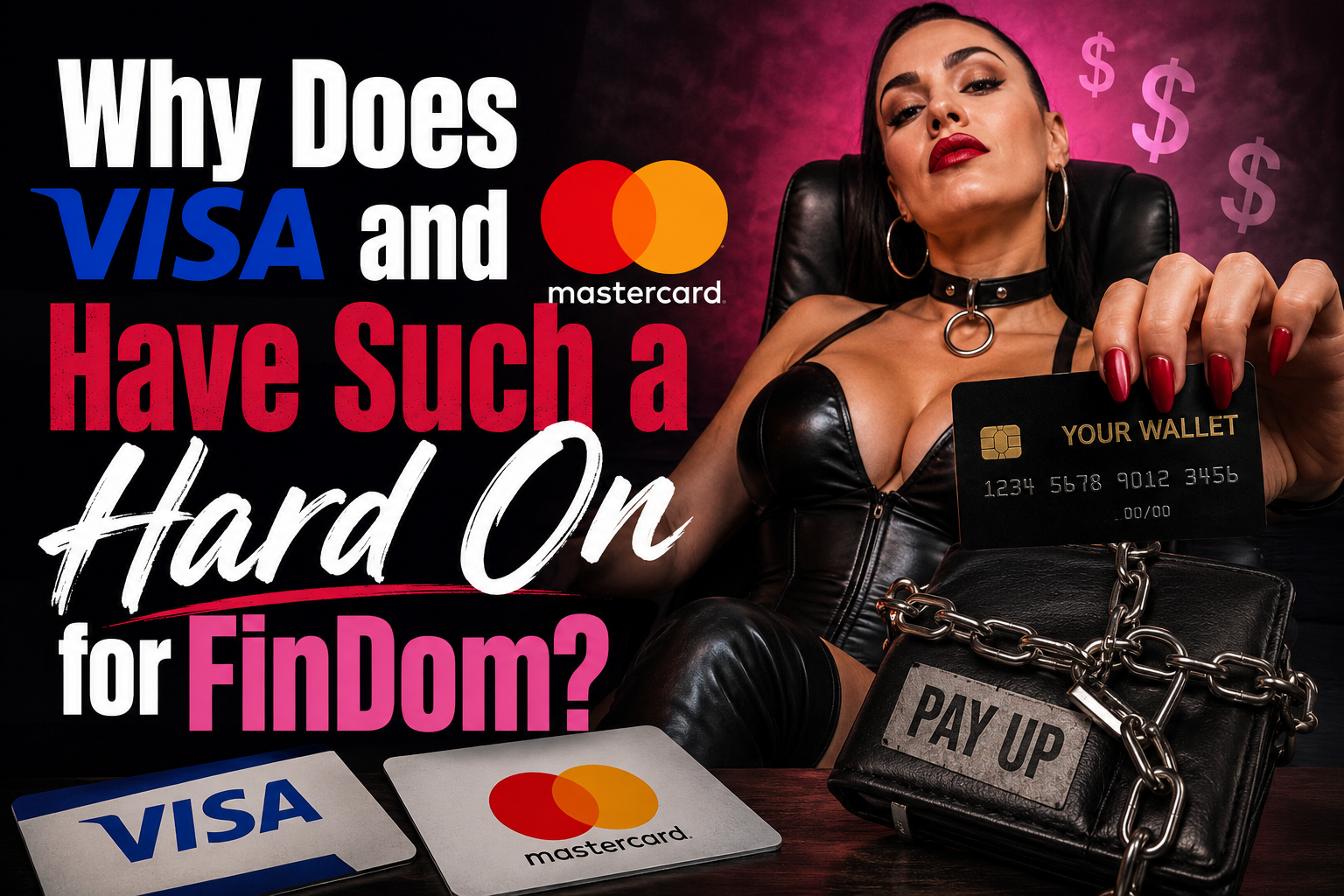
That is the exact reason Visa and Mastercard are increasingly viewing findom as a high-risk category, one dangerously close to coercion, blackmail, extortion, and exploitative financial behavior.
And if you understand the history of findom, you begin to understand why.

Financial domination, commonly shortened to “findom,” is a fetish built around power exchange using money as the primary mechanism of control.
Typically, the dominant participant, often referred to as a FinDomme, receives money, gifts, tributes, or financial control from a submissive participant who derives psychological, emotional, or sexual satisfaction from the act of giving.
Sometimes this involves:
- Sending tribute payments
- Paying bills
- Buying luxury gifts
- Handing over portions of income
- Public humiliation connected to spending
- “Wallet draining”
- “Cash slave” dynamics
- Paying simply for attention or acknowledgment
What separates findom from traditional adult content is that, in many cases, there is little or no nudity involved at all.
The transaction itself becomes the fetish. The power dynamic becomes the product.
And that psychological component is precisely what eventually caught the attention of the financial industry.
The Origins of Findom
Contrary to popular belief, findom did not begin on OnlyFans or Twitter. Its roots go back decades into traditional BDSM and female domination communities.
Historically, financial submission was part of dominance-and-submission (dom/sub) relationships. Wealthy submissives would sometimes voluntarily support dominant partners financially as part of consensual power exchange arrangements.
Back then, it was usually private. Small scale. Relationship based. But the internet changed everything.
In the late 1990s and early 2000s, online fetish forums, cam sites, and chatrooms created entirely new possibilities for remote domination. Suddenly, dominants no longer needed physical proximity to monetize power dynamics.
The rise of:
- Pay-per-message systems
- Tribute pages
- Webcam sessions
- Wishlist gifting
- Remote humiliation
- Online roleplay
turned findom into something scalable. Money itself became eroticized. And over time, social media would supercharge that transformation.
Financial domination exploded into mainstream internet visibility during the Twitter era. Twitter became the perfect ecosystem for findom because it encouraged:
- Public interaction
- Viral humiliation
- Instant payment methods
- Parasocial relationships
- Constant accessibility
Suddenly phrases like:
- “Pay pig”
- “Human ATM”
- “Wallet drain”
- “Cash slave”
- “Spoil me”
- “Tribute first”
were no longer hidden inside fetish communities.
They became social media branding. Creators realized something important: You did not necessarily need nudity to monetize attention. You could monetize emotional power itself.
And for a while, it worked incredibly well.
The Problem: BDSM Ethics vs Viral Monetization
Traditional BDSM communities generally emphasized:
- Consent
- Negotiation
- Boundaries
- Mutual understanding
- Risk awareness
- Aftercare
But as findom became profitable, many people entered the niche without any background in BDSM culture at all.
That created a major shift. What was once consensual fetish roleplay increasingly started looking like:
- aggressive financial pressure
- emotional manipulation
- humiliation tied to money
- encouraging reckless spending
- exploiting loneliness
- exploiting emotional vulnerability
And this is where the adult industry collided headfirst with the banking industry. Because Visa and Mastercard do not evaluate content through the lens of kink culture. They evaluate it through the lens of financial risk.

Why Visa and Mastercard Became Concerned
To understand the current crackdown, creators need to understand one brutal reality: Banks control the adult industry far more than adult platforms do.
OnlyFans, Fansly, and similar sites survive entirely because Visa and Mastercard allow them to process payments.
Without payment processing, these platforms effectively cease to exist.
That means payment processors have enormous influence over what kinds of content are considered acceptable.
And findom raises nearly every red flag possible for financial institutions. From the perspective of Visa and Mastercard, findom creates serious concerns involving:
- emotional coercion
- financial exploitation
- addiction-like spending patterns
- chargeback risks
- manipulation claims
- public relations disasters
- regulatory scrutiny
Even if both participants view it as consensual fantasy roleplay, the concern for banks is simple: What happens later if someone claims they were emotionally manipulated into spending money?
- That creates legal liability.
- And banks hate liability.
Especially after years of pressure from journalists, lawmakers, advocacy groups, and anti-porn organizations targeting adult platforms.
The findom situation is not happening in isolation.
Over the last several years, Visa and Mastercard have aggressively pressured adult platforms to tighten rules around:
- faceless creators
- identity verification
- AI-generated performers
- unverified participants
- consent documentation
- extreme fetish categories
Why? Because payment processors increasingly fear lawsuits, scandals, and accusations that platforms failed to protect users.
Findom now sits directly inside that danger zone because it blends:
- emotional influence
- money
- power imbalance
- psychological dependency
into one monetized interaction. To banks, that looks extremely risky.
Another reason findom attracted scrutiny is because it evolved beyond BDSM entirely. Modern social media transformed findom into influencer culture.
Many creators today no longer market themselves explicitly as BDSM dominants. Instead, they frame it as:
- “Princess treatment”
- “Spoiling”
- “Soft domme energy”
- “Luxury worship”
- “Pay for my attention”
- “Fund my lifestyle”
This blurred the lines dramatically. What once looked like niche fetish roleplay now increasingly resembles:
- emotional monetization
- parasocial manipulation
- exploitative spending behavior
And from a compliance perspective, banks are not interested in nuanced distinctions between consensual fetish roleplay and emotional exploitation.
They look at worst-case scenarios.
Platforms like OnlyFans understand exactly how fragile their relationship with payment processors really is.
One major controversy can create enormous pressure. That is why platforms have become increasingly strict about:
- identity verification
- consent documentation
- AI usage
- faceless content
- prohibited fetishes
They are not necessarily doing this because they morally object to the content.
They are doing it because Visa and Mastercard force them to.
And findom now represents one of the fastest-growing compliance concerns in adult content.
Because unlike traditional porn, findom centers directly around financial surrender and emotional influence.
That is a terrifying combination for financial institutions.
The controversy surrounding findom raises larger cultural questions:
- Is it consensual fantasy?
- Is it exploitation?
- Is it emotional labor?
- Is it manipulation?
- Is it empowerment?
- Is it addiction?
Supporters argue:
- adults should be free to engage in consensual financial roleplay
- findom is simply another BDSM dynamic
- people spend money on emotional experiences constantly
Critics argue:
- vulnerable individuals can be exploited
- loneliness is being monetized
- some creators intentionally encourage unhealthy spending behavior
- the line between fantasy and coercion becomes blurry
And that gray area is exactly what makes banks uncomfortable.
Financial domination probably is not disappearing anytime soon. But creators need to understand something extremely important: The adult industry is no longer shaped primarily by creators, fans, or even platforms.
It is shaped by banking compliance departments.
And right now, those compliance departments increasingly view findom as a major liability risk.
Whether creators personally agree with that assessment almost does not matter. Because in today’s adult industry, the people truly making the rules are not the creators.
They are the banks behind the credit cards. And that’s a problem.
The law no longer drives what you can and can’t do, Visa and Mastercard do.
About The Author