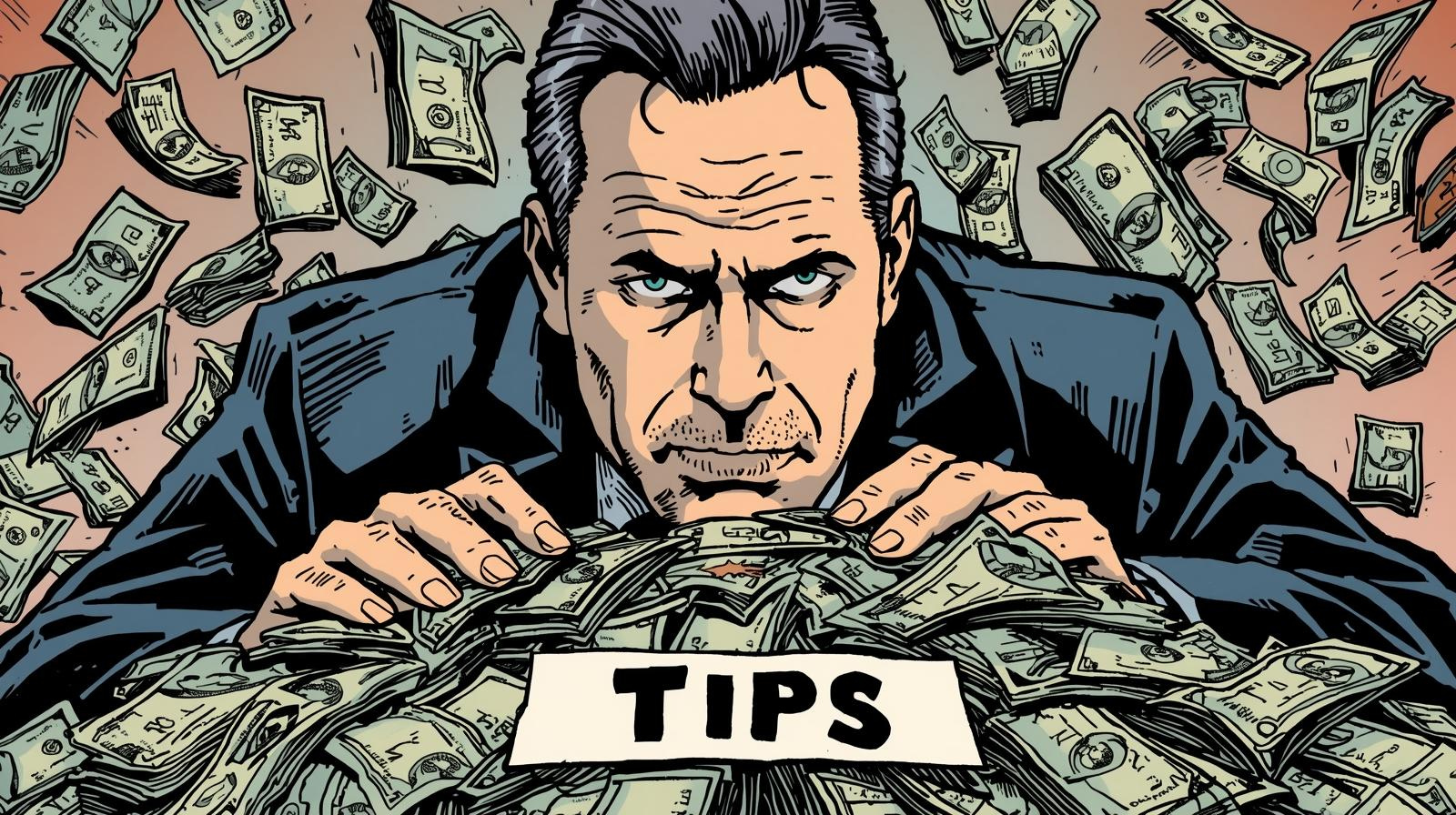
President Trump’s campaign-style promise of “no tax on tips” has now collided with one of Washington’s oldest legal headaches: defining pornography.
As part of the sweeping tax package signed on July 4th, the administration created a new deduction for service tips, offering workers a significant tax benefit. But the rule comes with a major caveat. Tips earned from prostitution or “pornographic activity” are explicitly excluded, and that exemption is quickly emerging as one of the thorniest problems in the entire bill.

The Treasury Department’s proposed regulations list nearly 70 occupations eligible for the new deduction, including entertainers, dancers, bartenders, plumbers, DJs, tattoo artists, and digital content creators. At first glance, that list seemed poised to include sex workers and online adult creators who regularly receive tips on platforms like OnlyFans. Instead, the administration inserted a carveout barring anyone engaged in “pornographic activity” from claiming the benefit.
Now the central question is unavoidable: how will the IRS decide what counts as pornography?
Tax professionals warn that enforcing the rule would require agents, or potentially Tax Court judges, to actually view the content in question. “Where’s the line?” asked accountant Katherine Studley, who represents OnlyFans creators. “Just because you’re on OnlyFans, that doesn’t necessarily mean it’s pornographic. You could have a cooking channel or a yoga channel.”
The history of U.S. law offers little clarity. Justice Potter Stewart’s famous 1964 remark, “I know it when I see it,” still stands as one of the Supreme Court’s most honest admissions about the difficulty of defining obscenity. The IRS, meanwhile, is accustomed to wading through vague categories; even the agency’s definition of a citrus grove is remarkably involved, but pornography presents uniquely subjective challenges.
Ultimately, experts say, the determination will fall to individual IRS examiners performing case-by-case reviews. “Sometimes you look at something, and it’s clearly pornography,” said tax educator Thomas Gorczynski. “But sometimes you look at something and think, ‘Eh, it’s subjective. Somebody might be really into it.’”
The law caps the deduction at $25,000 and phases it out entirely for individuals earning more than $400,000. Many top creators exceed that threshold anyway. One performer who earns roughly $2 million a year said that while she wouldn’t qualify, the exclusion still feels discriminatory, especially given that some of her highest-tipped content involves something as innocuous as feet.
The exclusion didn’t appear by accident. Socially conservative and Christian organizations urged the Trump administration to keep adult creators out of the new benefit, arguing that the government should not subsidize industries they consider harmful. Days after those groups sent a letter to Treasury Secretary Scott Bessent, the proposed rule appeared.
John Shelton, policy director for the conservative group Advancing American Freedom, acknowledged that pushing for such language is “sort of an embarrassing thing to bring up,” but described it as part of a broader effort to cement socially conservative priorities within the administration’s agenda.
The move arrives amid broader political battles over pornography. Project 2025, a Heritage Foundation blueprint aligned with Republican policy circles, openly calls for banning porn nationwide. While congressional Republicans have not embraced an outright ban, sex workers and adult creators say the direction of federal policy is unmistakable.
“This is the direction the government is moving in,” said financial planner Jessica Goedtel, who works with adult creators. “The IRS could be used as a tool.”
Even aside from ideological fights, the mechanics of the rule are daunting.
To determine whether a creator’s tips qualify, an auditor might have to review posted content, including explicit videos, to classify it as pornographic or not. The sheer popularity of platforms like OnlyFans, where users spent 7.2 billion dollars last year, raises questions about staffing and enforcement. And the government’s attempt to single out a poorly defined category for special tax treatment is raising alarms among accountants.
“If you’re trying to single out a type of income that’s not that well defined for special tax treatment, yeah, it gets complicated,” said Annette Nellen, a tax policy professor at San Jose State University. “Special rules are always complicated.”
The situation is further complicated by the fact that OnlyFans hosts an enormous range of content — much of it explicit, but not all. According to the site’s parent company, OnlyFans now supports roughly 4.6 million creator accounts and more than 377 million fan accounts worldwide. Whether any meaningful portion of those users will be audited — or how investigators will draw a line between “pornographic” and “not pornographic” — remains an open question.
The possibility of the IRS policing pornographic content underscores a larger national tension: federal agencies are increasingly pulled into culture-war battles over sexuality, digital content, and the rights of workers in the adult economy.
The “no tax on tips” promise may have sounded simple on the campaign trail. In practice, it has produced one of the strangest policy questions of the year — leaving the IRS to decide, occupation by occupation and video by video, who is too pornographic to qualify for a tax break.
And unless Congress revises the rule or courts strike it down, those determinations may soon be made not by lawmakers, but by IRS agents staring at OnlyFans screens and trying to answer one question: Is this pornography?
About The Author