They called it the Prevent Exploitation of Women and Minors Act, which sounded comforting. Protective. Like a seatbelt.
Catjira (@catjiratv) learned the hard way that it was more like a trapdoor.
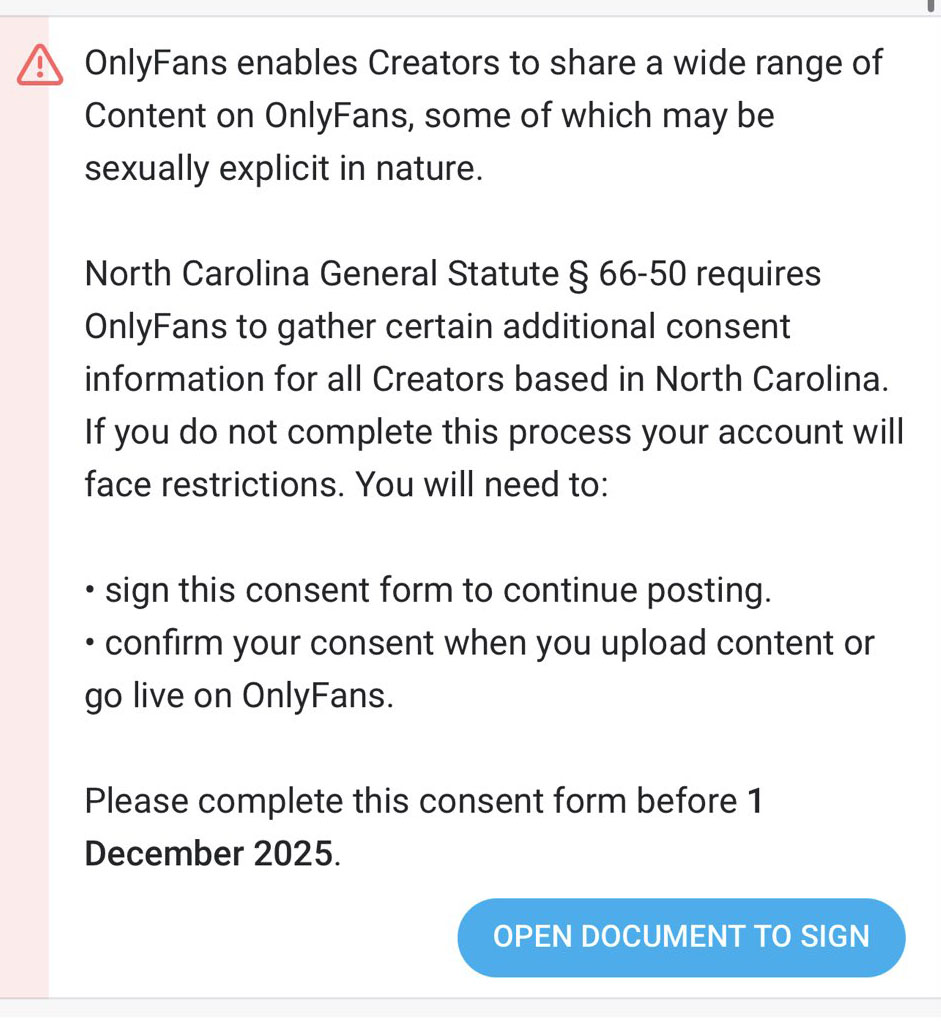
The message didn’t arrive with flashing lights or sirens. It came quietly, dressed in polite legal language, informing her that content she had uploaded—months, even years ago—was now subject to new rules. Rules that didn’t exist when the camera was rolling. Rules that didn’t care about the contracts she already had.
In North Carolina, she learned, contracts could be erased by time and geography.
- Consent forms? Suddenly incomplete.
- Past agreements? Suddenly irrelevant.
Under the new law, it didn’t matter if a performer had signed willingly, enthusiastically, and with legal counsel. Consent could now be withdrawn at any time—for any reason—and platforms were required to obey within seventy-two hours. No debate. No court order. Just a clock ticking down.
Worse, consent was no longer a single yes.
It had to be explicit.
Written.
Granular.
Every act, every scene, every moment spelled out and archived.
And not just collected—but collected before upload.
Platforms were required to hold it all: age verification, identity records, written consent to distribute, and a carefully worded explanation of what the state considered “coerced consent,” along with a reminder that consent could always be taken back.
Even content created long before the law existed was suddenly fair game.
Retroactive, they called it.
If someone asked for a takedown—whether by the performer, their representative, or law enforcement—the platform had 72 hours to remove it. Miss that window, and the penalties began stacking like dominoes: per image, per day, relentlessly.
Ten thousand dollars a day. Per image.
- Edited versions? Also banned.
- Reuploads? Forbidden.
- Mistakes? Expensive.
The attorney general could sue. So could the performer. And if the platform forgot to post clear takedown instructions—just forgot—there was a twenty-four-hour grace period before fines began bleeding in at ten thousand dollars a day.
For takedowns ordered by the state, the countdown was even shorter.
- Twenty-four hours.
- Five thousand dollars per day.
- No pause button.
Creators began whispering to each other online, trading horror stories like survival tips. One lived on the Tennessee border, her internet unreliable, bouncing between servers. She ran a speed test out of desperation.
North Carolina. Her account was locked before she even understood why.
It didn’t matter that she didn’t live there. It didn’t matter that the content wasn’t made there. It didn’t matter that the law hadn’t existed yet. What mattered was that the system thought she was there now.
December 1, 2025, loomed like a fault line—one moment before, one moment after. Rules suddenly judged everything uploaded in the past as if it were from the future.
The lesson spread fast: If you are a creator, location is no longer where you stand.
- It’s where your data passes.
- Where your ISP routes you.
- Where the platform decides you belong.
And in North Carolina, consent is no longer a signature. It’s a nightmare.
And the very reason why many platforms are banning anyone from the state altogether. But even worse, now people who don’t live there are having issues, too.
So let me remind you one last time, if you are driving through the state, please don’t make the mistake of opening your OnlyFans account. It could cause your account to get locked down.
About The Author